
U.S. praises India’s arrests in bust of call center scamming Americans

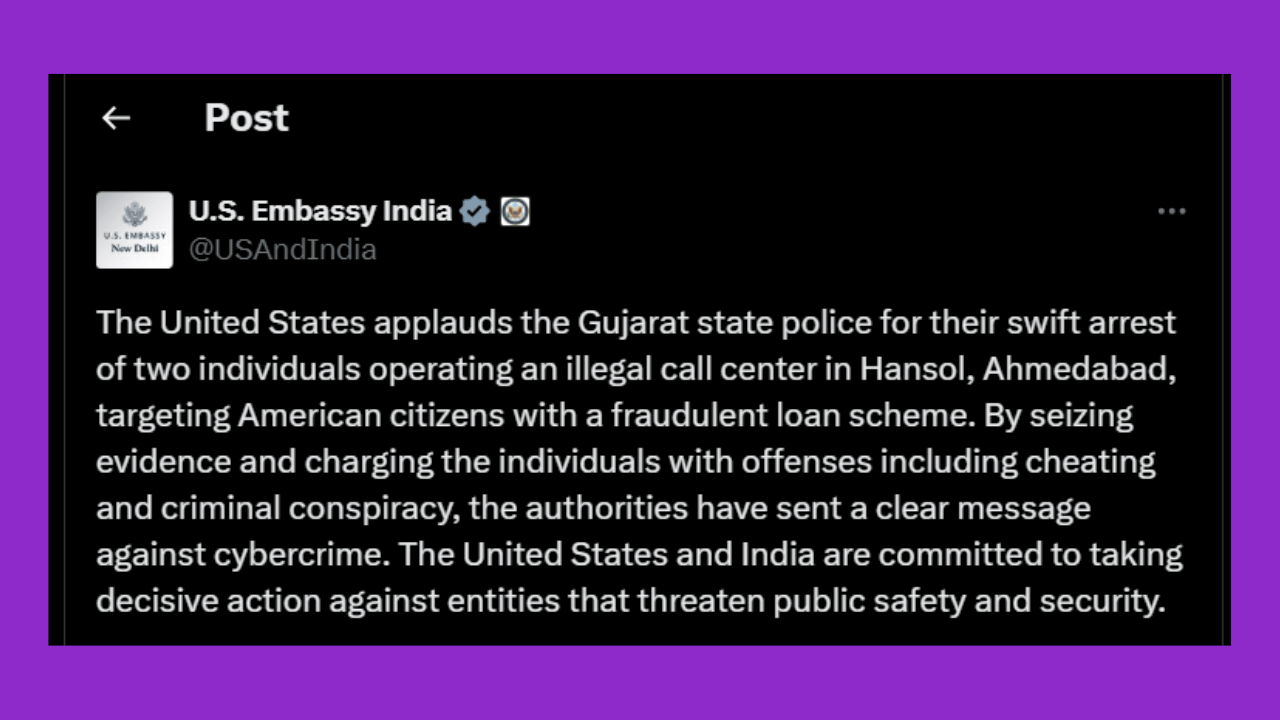
NEW DELHI, INDIA — The United States has commended Gujarat Police for swiftly arresting two individuals operating an illegal call center in Ahmedabad, India that scammed American citizens through a fake loan scheme.
U.S.-India cooperation in combating cybercrime
The U.S. Embassy in India, in a statement on X, praised the authorities for their success in acquiring evidence and indictments in the endeavor to facilitate Indo-U.S. collaboration in the war against cybercrime.
“The United States applauds the Gujarat state police for their swift arrest of two individuals operating an illegal call center in Hansol, Ahmedabad, targeting American citizens with a fraudulent loan scheme,” they write in the statement.
The case is a reflection of the level of cooperation between these two countries in matters of protecting the people against online fraud.
Improved coordination is also being seen in cross-border law enforcement, as cybercrimes against foreigners, especially through impersonation and financial fraud, have increased.
The Ahmedabad action can be used as a benchmark for future crackdowns; hence, it exhibits how local authorities are capable of effectively breaking down illegal operations that have international consequences.
As the two nations intensify their pressure on organized web-based fraud networks, they are likely to further enhance their cybersecurity collaboration.
Fighting threat of fake call centers and financial scams
The Ahmedabad bust indicates that call center scams remain common in India, victimizing people in other nations through fraudulent schemes, including loan calls and identity theft.
Fake call centers can be found all over India despite numerous crackdowns, as they run on control gaps and the anonymity that technology provides. The Gujarat Police’s swift response in Hansol sends a serious message to potential offenders.
The U.S. embassy reiterated its commitment to protecting the public, noting in its statement that “The United States and India are committed to taking decisive action against entities that threaten public safety and security.”
Proactive efforts on call-blocking technology notwithstanding, scammers use fear and urgency conditioning that hustles victims to give confidential information or move money.
As dynamic fraudulent call centers and financial scams emerge, governments have warned people to be vigilant in dealing with increasingly sophisticated scams, including but not limited to impersonation and ransomware.
Related news
- Philippines’ new tax incentives to boost BPO industry growth: official · 3 Dec 2024
- Conduent shows mixed Q2 2025 results, EBITDA up 54% amid revenue dip · 11 Aug
- Miami hotel’s Indian virtual front desk ignites job outsourcing debate · 9 Aug
Disclosure: Outsource Accelerator uses AI tools in the backend of its editorial workflow. Every article is reviewed and verified by a human editor before publication.
Stay ahead of the outsourcing industry. Join thousands of business leaders who rely on Outsource Accelerator for the news, trends, and expert insights that matter. Subscribe to our free newsletter and never miss an update.








