
BPOs evolve social impact, champion communities: OIR 2025

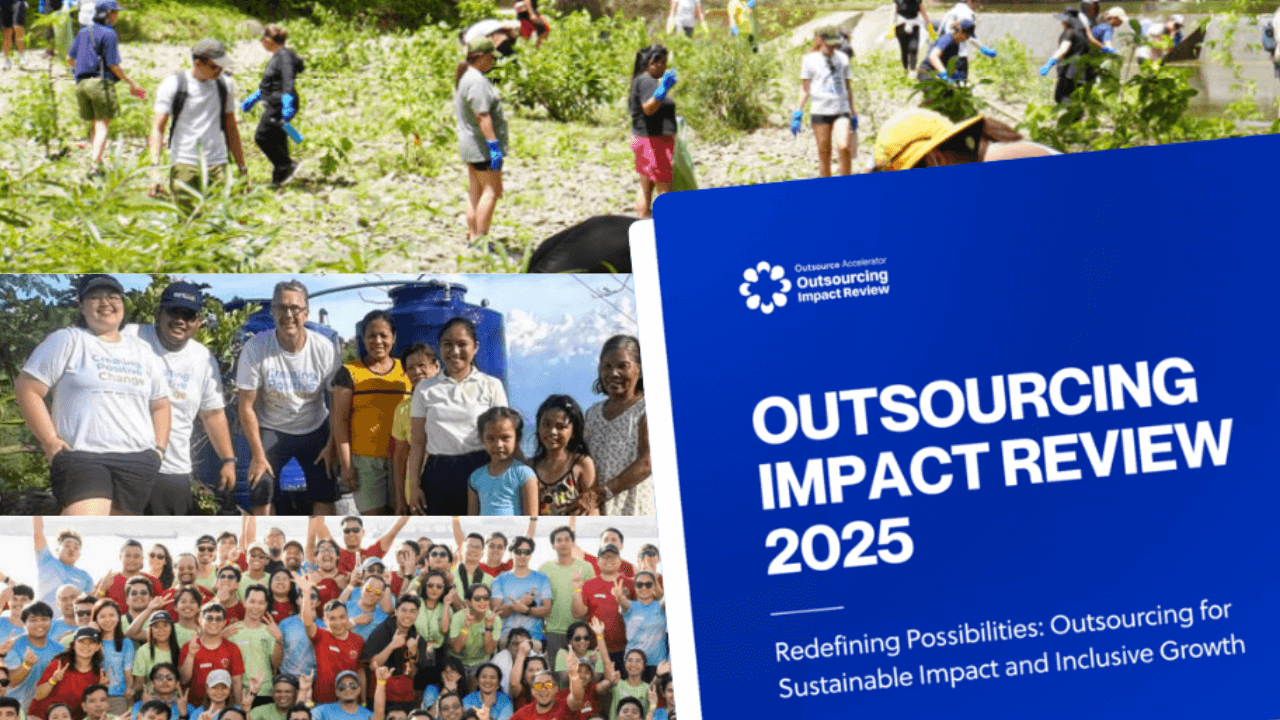
MANILA, PHILIPPINES — The global business process outsourcing (BPO) industry is significantly shifting its social impact strategy, moving its primary focus to community building.
Community building regains top BPO social priority
Community building has been the primary theme of BPO social activities in 2025, accounting for 46.2% of all projects. This trend repeats from OIR 2023, with community building being the top category at 41%, which contrasts with OIR 2024, where education was the most prominent at 42.1%.
According to Outsource Accelerator’s Outsourcing Impact Review (OIR) 2025, which analyzed a record of 31 finalists, the data reveal that the industry is resetting its agenda on the wider, locally based community resilience and multi-need responses.
The example of this strategic reorientation is companies such as Booth and its Golden Award-winning project, Rooted in Community. This project collaborates with organizations to establish reforestation and food security programs.
Another notable achievement is the Probe’s Solar-Powered Clean Water Project, which provided clean water infrastructure to a Philippine island, demonstrating that BPOs are utilizing infrastructure and technology to meet basic community needs.
Diversity, equity, and inclusion becomes industry standard
DEI has become an indisputable part of responsible outsourcing, not decreasing its role in actions over the years of reporting.
Inclusive workplaces continued to reflect a commitment to investment, with DEI accounting for 20.5% of projects in 2025, a figure nearly identical to its shares of 21.1% in 2024 and 21.3% in 2023. This unity serves to emphasize the idea that DEI is no longer a side project but a minimum requirement that is incorporated into corporate culture.
Through programs such as the “Innodata DEIB Program,” which has won the Gold Award, diversity and belonging have been integrated into every aspect of employees’ experiences, resulting in 91% of employees reporting that they feel fairly treated.
Similarly, OfficePartners360’s “Building a Stage” initiative achieved and maintained 50% female representation in global leadership, proving that strategic DEI commitments yield tangible business and social benefits.
Health and wellness initiatives show steady growth
The category of impact that shows a definite, positive change over the three years is health and wellness, which increases from 11.5% in 2023 to 17.9% in 2025.
This constant increase demonstrates a reflective transformation in the discernment of holistic well-being as a strategic priority to employees and communities served by the BPOs. Employers are not just focusing on physical wellness, but also on mental wellness and financial wellness.
Arcanys’ Gold Award-winning “Health & Wellness Program with a Charity Match” created a unique model where employee workouts generated donations for a children’s foundation.
Gear Inc. addressed the specific psychological risks faced by content moderators through its “From Hire to Retire: Building a Resilient Employee Journey” program, utilizing VR and AI to build resilience and providing over 8,000 individual well-being check-ins.
BPO industry rebalances its education focus
Following a peak in 2024, where it led all categories at 42.1%, the focus on education adjusted to 15.4% of initiatives in 2025. This shift suggests a rebalancing of the industry’s impact portfolio rather than a diminished commitment, returning closer to its 2023 level of 26.2%. The current educational projects are often deeply integrated with technology and community development.
The most prominent is the Hugo Academy, the Overall Impact Champion of the report, which helps bridge the education-to-employment gap among African youth, with graduation rates of 1,320 and a placement rate of 668 in remote employment.
At the same time, the Digitized Library in Rural Thailand project, initiated by TDCX, has converted an old library into a new digital library, serving more than 2,900 students and other community members, and bridging the digital divide.
“By connecting economic opportunity, education, community building, and environmental stewardship, outsourcing amplifies its transformative capacity to empower individuals, families, and whole communities,” the report notes.
Related news
- Hugo, other BPOs lead Outsourcing Impact Review 2025 · 20 Oct
- SixEleven, other BPOs shine in Asia CEO Awards 2025 · 9 Oct
- Small businesses lead outsourcing industry’s social responsibility revolution: OIR 2024 · 22 Nov 2024
Disclosure: Outsource Accelerator uses AI tools in the backend of its editorial workflow. Every article is reviewed and verified by a human editor before publication.
Stay ahead of the outsourcing industry. Join thousands of business leaders who rely on Outsource Accelerator for the news, trends, and expert insights that matter. Subscribe to our free newsletter and never miss an update.








