
U.S. firms stay committed to India despite trade delays — USISPF chair

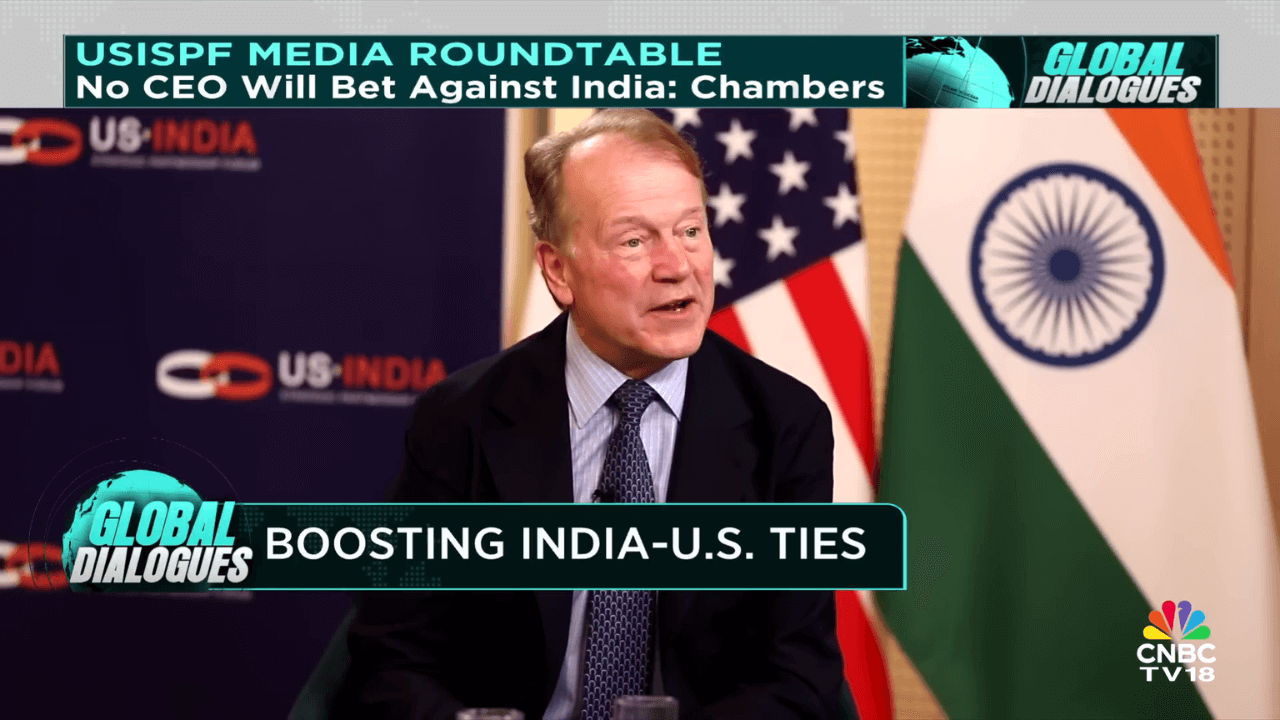
UTTAR PRADESH, INDIA — American firms remain firmly committed to India despite temporary slowdowns in trade negotiations, with United States business leaders focusing on the long-term strategic potential of the partnership, chairman of the United States–India Strategic Partnership Forum (USISPF).
Long-term vision drives U.S. investment in India
Speaking to CNBC-TV18, Chambers described the current trade situation as a “short-term bump” that will not disrupt the broader momentum of the bilateral relationship.
According to John Chambers, “They see this as a short-term bump. They don’t view it as something that’s going to disrupt our long-term relationships and I absolutely agree with that. I’m very optimistic about what we’re going to see between the U.S. and India,” he said.
Chambers emphasized that American companies are making decisions with five-, ten-, and fifteen-year horizons, rather than reacting to election cycles or quarterly results.
“Almost no CEO is going to bet against India as a key partnership as you move forward. Businesses do not make decisions on whether the deal will get done this month or next quarter. When you bet on India, you’re betting five, ten, fifteen years out—and you’re committing billions of dollars,” he noted.
Highlighting India’s rise on the global economic stage, Chambers recalled that when he positioned Cisco’s second global headquarters in India two decades ago, the country ranked 12th in global GDP.
“You and I have talked about whether India could be a startup nation… and who’s the number one IPO market now in the world for startups? It’s India,” he said, adding that many of the American companies are now betting on manufacturing in India.
USISPF network, private capital anchor India-U.S. ties
Under Chambers’ leadership, USISPF has grown to 450 member companies, all of which are “all in and investing in India’s future,” according to the chairman.
He also stressed that the strength of India–U.S. business ties lies in the longstanding “network of interrelationships between government and business” that has been built over the years.
“If you’d watched the last two days, you’d see from the government leaders in India and from business leaders from the U.S. a united view in terms of what we can do together,” Chambers said.
Chambers himself continues to scale investments in India, managing 24 startups, 11 unicorns, and two decacorns. The U.S.–India partnership, he suggested, is not just about trade deals but long-term collaboration in technology, manufacturing, and innovation.
The long-term commitment reinforces India’s position as a premier destination for global business services. With U.S. firms deeply embedded across technology and manufacturing sectors, the continuity of investment signals sustained growth for India’s outsourcing and startup ecosystem, offering global companies a stable environment for scaling operations over the next decade.
Related news
- Vietnam emerges as top global software outsourcing hub, analyst says · 19 Nov
- India GCCs to reach 2,400 by 2030 despite H-1B restrictions · 19 Nov
- Philippine senator files bill to boost job security for BPO workers · 18 Nov
Disclosure: Outsource Accelerator uses AI tools in the backend of its editorial workflow. Every article is reviewed and verified by a human editor before publication.
Stay ahead of the outsourcing industry. Join thousands of business leaders who rely on Outsource Accelerator for the news, trends, and expert insights that matter. Subscribe to our free newsletter and never miss an update.








