
IT-BPM drives Philippine office market growth in Q3 2025: SKF report

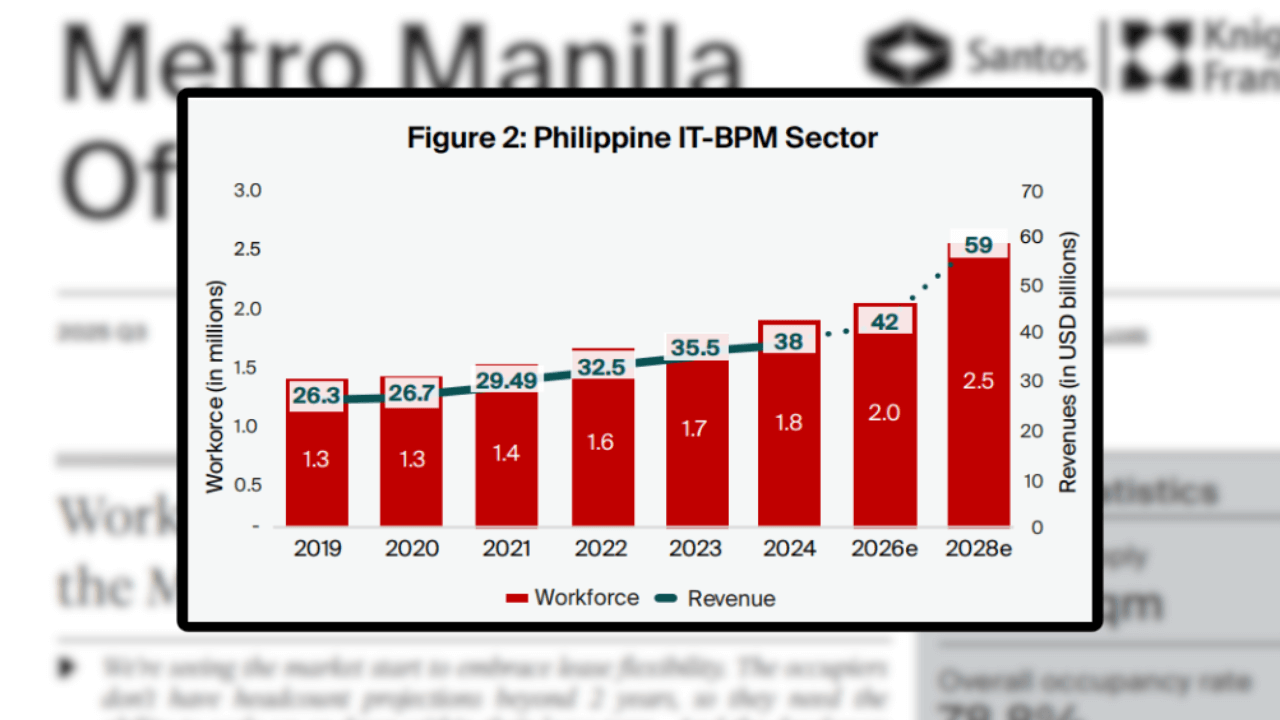
- Philippine office demand is being driven by the IT-BPM sector
- Year-to-date absorption reached 461,245 square meters
- Over 1.5 million square meters are due for completion through 2029
- Taguig commands PHP1,242 per square meter monthly, 23% above average
MANILA, PHILIPPINES — The Philippines’ office market is entering a new cycle of expansion, driven primarily by the information technology and business process management (IT-BPM) sector.
“The office market in the Philippines is not merely recovering but entering a renewed cycle of expansion, strongly underpinned by the strategic needs of the IT-BPM sector,” Morgan McGilvray, SKF Senior Director for Occupier Strategy and Solutions, told reporters in a press briefing.
Return-to-office trend fuels workplace demand
According to a BusinessMirror report, McGilvray noted that the trend is “shifting decisively” back to centralized workplaces despite concerns over the long-term viability of physical office space.
According to a report from Santos Knight Frank (SKF), large multinational corporations and Silicon Valley-influenced companies are realizing the limitations of purely remote setups, particularly when it comes to team cohesion, socialization, mentorship, and real-time problem-solving.
In the Philippines, this shift is amplified by the nation’s social culture, which highly values face-to-face interaction.
“The office becomes a crucial hub for developing the ‘crucial and irreplaceable’ skills of the future, such as empathy, negotiation, and complex problem-solving, which are less susceptible to automation by AI,” McGilvray said, emphasizing the growing strategic role of office spaces beyond mere operational needs.
Provincial markets attract build-to-suit developments
While IT-BPM has historically been concentrated in Metro Manila and driven by U.S.-based companies, its growth is now expanding to provincial areas.
“Strong growth is anticipated in provincial areas, as developers shift from speculative builds to more secure, pre-committed build-to-suit (BTS) arrangements. This is evident in locations like Cebu, where large tenants collaborate with developers to customize office buildings to precise operational and security specifications,” McGilvray said.
This approach not only secures long-term occupancy but also encourages modern, high-quality office development outside the capital.
According to the study, year-to-date absorption reached 461,245 square meters, largely driven by IT-BPM expansions.
Metro Manila’s office pipeline remains robust, with over 1.5 million square meters scheduled for completion through 2029, primarily in Quezon City, Taguig, and Ortigas.
Taguig continues to command the highest average asking rate at PHP1,242 (US$20.87) per sqm/month, 23 percent above the overall average of PHP1,007 (US$17.12) per sqm/month.
McGilvray also highlighted that demand is increasingly coming from non-US markets, particularly Europe and Australia. This trend not only mitigates risks from over-reliance on a single economy but also reinforces the Philippines’ reputation as a high-quality, versatile outsourcing destination.
The mentioned development is indicative of the overall maturation of the Philippine IT-BPM sector, making the country a competitive hub for global outsourcing, while at the same time, driving the continuous growth of office infrastructure in both urban and provincial centers.
Related news
- AI boosts customer service jobs, not cuts: Gartner survey · 13 Dec
- Capgemini India outpaces GCC export growth at 18% CAGR · 13 Dec
- BPOs and tech leaders in Asia dominate 2025 ACES Awards · 12 Dec
Disclosure: Outsource Accelerator uses AI tools in the backend of its editorial workflow. Every article is reviewed and verified by a human editor before publication.
Stay ahead of the outsourcing industry. Join thousands of business leaders who rely on Outsource Accelerator for the news, trends, and expert insights that matter. Subscribe to our free newsletter and never miss an update.








