
California law requires food delivery apps to offer human support

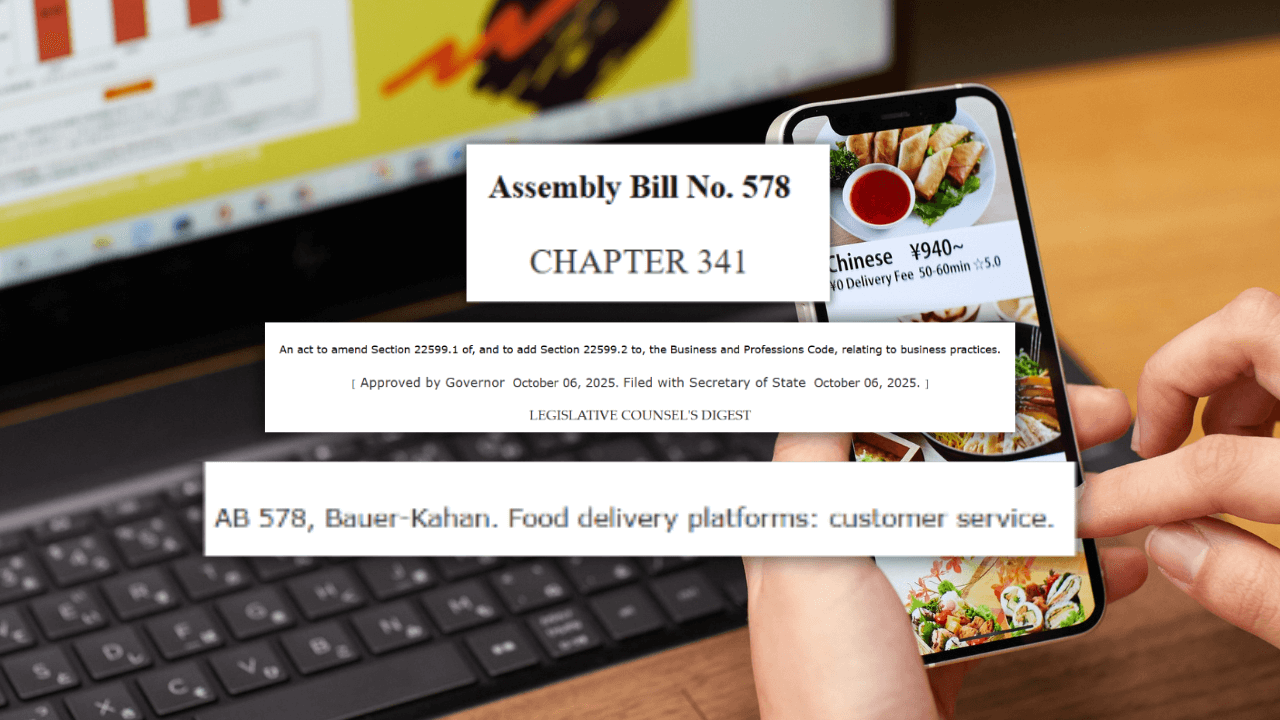
- California food delivery customers gain a right to human support
- Refunds must be issued in the original payment form
- The governor signed the legislation in October 2025
- It covers Uber Eats, DoorDash, Grubhub and Postmates
WASHINGTON, UNITED STATES — California food delivery customers gained the right to speak directly with a human customer service representative under a new law designed to curb overreliance on automated systems.
The legislation also ensures refunds can be issued in the original form of payment if an order is incorrect or undelivered, signaling the state’s push to balance automation with accountability.
New rules for human support
According to a report from CX Dive, “When orders go wrong, customers deserve transparency and real support: not hidden fees or automated runarounds,” said Assemblymember Rebecca Bauer-Kahan, who introduced the bill in 2025 in an Instagram post.
Governor Gavin Newsom signed the legislation in October 2025, mandating that companies like Uber Eats, DoorDash, Grubhub, and Postmates provide human assistance when automated systems fail to resolve issues.
The law sets clear boundaries for how food delivery platforms can rely on automation.
While artificial intelligence (AI) can still handle routine inquiries, platforms must now ensure that unresolved problems are promptly escalated to a human representative, challenging the “deflection-first” approach that has dominated the industry for years.
“This should worry all customer service leaders who have misapplied AI where their customer cannot get access to something as simple as a refund without becoming incredibly frustrated. Because now it’s not just an unhappy customer, but a potential regulatory consequence when AI doesn’t work,” said Vasili Triant, CEO of AI-powered contact center platform UJET, emphasizing the stakes for companies.
AI in food delivery customer service
Experts stress that AI is not banned, but its deployment must prioritize meaningful resolution.
“The moment AI starts making customer decisions, trust becomes the product. If it’s approving refunds or handling disputes, it has to recognize edge cases, escalate when needed and explain its decisions — human in the loop or not,” said Jeff Fettes, CEO of AI platform Laivly.
For the outsourcing industry, California’s law highlights the continuing importance of human agents even in heavily automated environments.
Companies providing outsourced customer support will need to adapt AI strategies that integrate human oversight to maintain regulatory compliance and customer satisfaction.
Platforms for food delivery that are entirely dependent on automated systems may encounter risks of losing their reputation and risks of regulatory scrutiny. However, combining AI efficiency with human judgment can not only build trust but also enhance operational resilience.
California’s approach could set a model for global customer service standards, underscoring that even in a high-tech world, human expertise remains indispensable.
Related news
- Neglecting EX and CX drives hidden business costs, expert warns · 24 Sep 2025
- Anthropic reveals how Claude’s personality gives it edge in global CX · 19 Jun 2025
- AI adoption in contact centers lags hype amid strategy, cost hurdles · 13 Jun 2025
Disclosure: Outsource Accelerator uses AI tools in the backend of its editorial workflow. Every article is reviewed and verified by a human editor before publication.
Stay ahead of the outsourcing industry. Join thousands of business leaders who rely on Outsource Accelerator for the news, trends, and expert insights that matter. Subscribe to our free newsletter and never miss an update.








