
Global RCM market to hit $117.5Bn by 2030: MarketsandMarkets

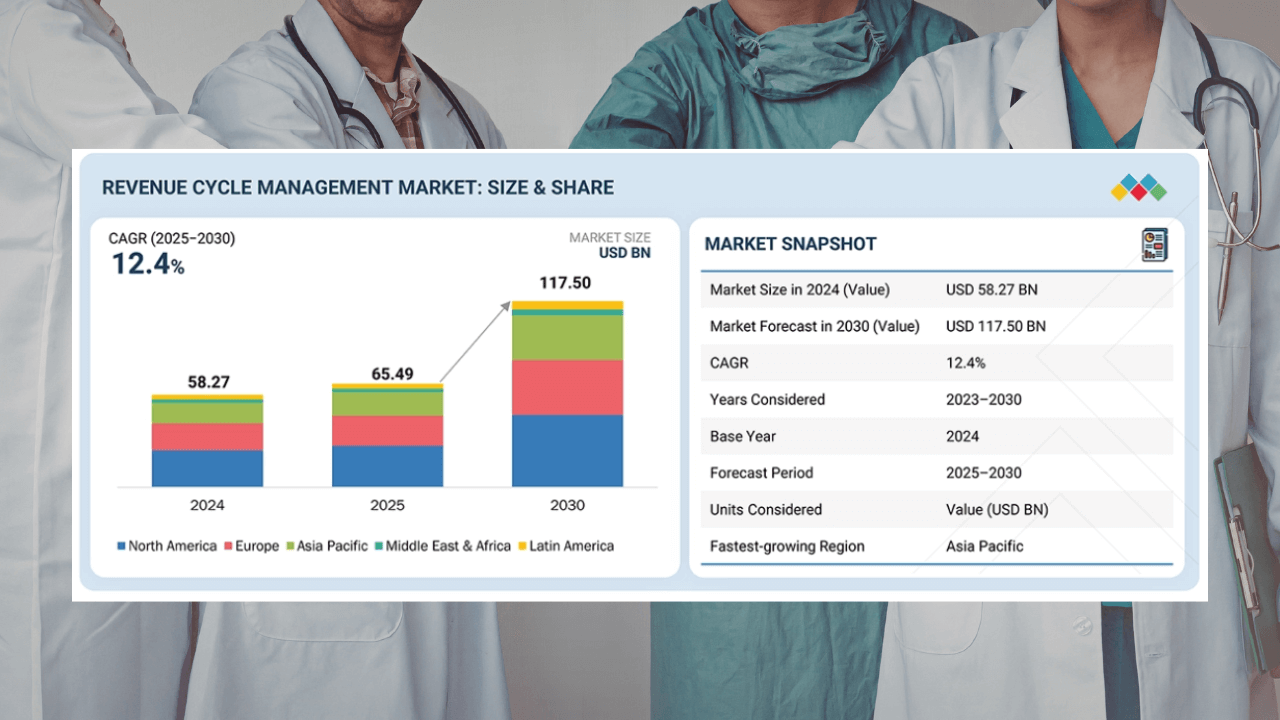
- The revenue cycle management market should reach $117.5 billion by 2030
- It was worth $58.27 billion in 2024 and $65.49 billion in 2025
- Growth runs at a 12.4% compound annual rate
- Outsourcing accounts for about 60% of total revenue
FLORIDA, UNITED STATES — United States hospitals and health systems grappling with rising costs and complex reimbursement rules are helping propel the global revenue cycle management (RCM) market toward $117.5 billion by 2030, as providers increasingly turn to technology and outsourcing to protect margins.
The market, valued at $58.27 billion in 2024 and estimated at $65.49 billion in 2025, is forecast to expand at a 12.4% compound annual growth rate (CAGR) as healthcare providers overhaul how they manage billing, collections, and compliance.
According to a forecast from MarketsandMarkets, MarketsandMarkets said the sector is seeing “unprecedented expansion,” fueled by economic strain and a shift toward value-based care.
The revenue cycle operations have transformed into a strategic priority for U.S. providers as their administrative workload has increased while their profit margins have decreased.
Rising costs push healthcare providers to modernize RCM
The report showed that healthcare organizations face major challenges, which include their increasing operating expenses, complicated regulations, and their new payment systems. The report also showed that these pressures make executives need to develop new methods for managing their financial operations.
These forces are driving a move away from traditional billing toward what the firm described as “intelligent, data-driven financial ecosystems.”
U.S. hospitals and physician groups now prioritize their objectives, which include reducing claim denials and accelerating cash flow while ensuring compliance with federal program requirements.
MarketsandMarkets noted that “rising claim denial rates that erode profitability” and administrative inefficiencies are key challenges prompting investment in revenue cycle tools.
As a result, providers are expanding the use of electronic health record (EHR) integration, automation, and analytics to improve accuracy and financial visibility.
“Healthcare providers remain the primary end-user segment, facing mounting pressure to optimize revenue collection amid declining reimbursements and increased patient financial responsibility,” the report said in a press release.
Outsourced and AI‑driven RCM solutions fuel market growth
Outsourcing continues to dominate the market, accounting for about 60% of total revenue.
The research firm said providers are turning to specialized vendors to “convert fixed operational costs into variable expenses” while gaining access to expertise in billing rules and payer requirements.
Current technology trends demonstrate their ability to transform revenue management procedures used by U.S. healthcare providers. AI-enabled RCM solutions represent the most rapidly expanding market segment, which will experience a 14.2% CAGR through 2030.
The forecast reported that companies use machine learning technology for predictive denial prevention, natural language processing to create automated coding systems, and analytics to achieve real-time financial monitoring.
Hospitals are adopting cloud-based RCM platforms as these systems provide flexible scaling capabilities and reduce their operational expenses. The North American market achieved a 40.3% market share in 2024 as health IT systems had already reached established levels and regulatory requirements.
MarketsandMarkets warned about cybersecurity dangers, which continue to be a major worry for most providers. The reports about data breaches demonstrate that RCM systems have security weaknesses that require providers to invest in protective measures as they manage confidential financial and medical information.
The RCM market is evolving beyond billing into comprehensive financial intelligence platforms, a shift that could help U.S. healthcare providers stabilize revenue and adapt to an increasingly complex payment environment.
Related news
- U.S. health systems turn to AI for growth, efficiency in 2026 · 5 Feb
- Select VoiceCom named Clutch Global Leader for 2025 in medical billing · 4 Feb
- Smarter care solves hospital bed shortages, not expansion: expert · 4 Feb
Disclosure: Outsource Accelerator uses AI tools in the backend of its editorial workflow. Every article is reviewed and verified by a human editor before publication.
Stay ahead in healthcare outsourcing. Join thousands of healthcare and business leaders who rely on Outsource Accelerator for the news, trends, and expert insights shaping medical BPO and the future of care delivery. Subscribe to our free newsletter and never miss an update.








