
Gen Z embraces AI despite fears of cognitive decline — report

- The survey covered 2,500 Americans aged 18 to 28
- 79% say AI is making people lazier
- 62% worry AI is making people less intelligent
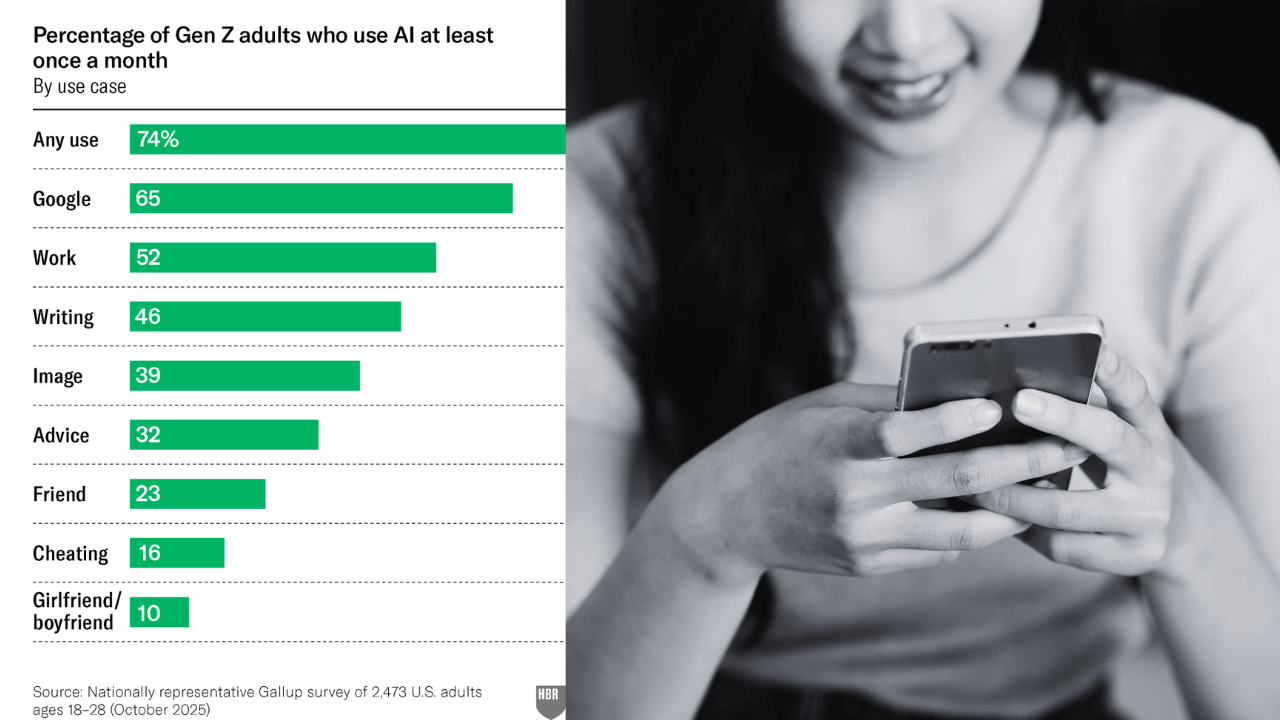
- 74% had used an AI tool in the previous month
NEW YORK, UNITED STATES — A new report reveals a profound paradox within Gen Z. While a large majority believes artificial intelligence (AI) fosters laziness and diminishes intellect, their personal usage of the technology is accelerating rapidly, even in defiance of workplace bans.
The study was conducted by Harvard Business Review in partnership with Gallup and the Walton Family Foundation in October 2025, and underscores a generation caught between anxiety over AI‘s cognitive consequences and the practical imperative to harness its efficiency.
Paradox of AI adoption and anxiety
The 2,500-person survey of American adults aged 18 to 28 found that 79% felt AI is making people lazier, and that 62% were concerned AI was making people less intelligent.
This ambivalence is based on more general anxiety, and almost a fifth of Gen Z have concerns that AI would put them out of a job. As Benjamin Lira Luttges, who led research on the report, told Fortune, “What we find is deep ambivalence on how Gen Z is thinking using AI.”
The most prevalent one is the fear that technology is turning people into idiots, a claim repeated in the academic literature of institutions such as Microsoft and Carnegie Mellon University, which found that excessive use of AI applications such as ChatGPT can erode critical thinking.
These widespread fears notwithstanding, Gen Z’s use of AI is soaring. It indicates that 74% of the polled consumers had used an AI tool, such as a chatbot, in the final month before the October 2025 poll, a significant increase from a Pew Research Center survey in which 58% of young adults reported using bots at all in February 2025.
Interestingly, 1 out of every 6 stated that they had used AI in the workplace, even when it was evidently prohibited.
This paradox shows a shift in the paradigm of a generation that emphasizes short-term productivity rather than the risk of atrophied thinking, which is not concrete but, in the long term, more decisive.
How Gen Z’s AI habits reshape workplace norms
The ambivalent feelings of Gen Z about AI are bound to influence the very nature of its implementation in the workplace, suggesting that addressing ambivalence rather than prohibition is more feasible.
This tension is paramount to the realization of an effective future of work. “Young people lead the adoption of new technologies, and a lot of things that are often seen as fringe, as not mainstream, are adopted by young people and eventually become part of the mainstream,” Luttges said.
“So in a sense, looking at Gen Z is a way of looking towards the future of work.”
According to Fortune, the survey data support a potential reduction in anxiety with exposure, as respondents who used AI more frequently worried less about its impact on intelligence and motivation.
Nevertheless, addressing personal anxiety is not a solution to the organizational risk of a deficiency in critical thinking.
Scholars such as Mark Beasley, a Professor at North Carolina State University, caution that relying too heavily on AI to complete entry-level jobs will create a skills gap that could jeopardize future leadership in the middle and upper ranks.
“The biggest risk organizations face is just being stagnant,” Beasley said.
However, Luttges believes that technology will not significantly impact critical thinking as long as workplaces are intentional in how they implement AI.
“There is effort that is germane to the task, that is intrinsic to the thing that you’re doing, and that that kind of effort is the effort that you put in, and gets translated into learning,” Luttges said.
“You should outsource the crap, not the craft,” he added.
This approach suggests workplaces must guide AI use to automate mundane tasks while preserving core analytical work, thereby mitigating the risk of cognitive stagnation.
This widespread, defiant adoption amid deep-seated anxiety signals that Gen Z is charging ahead to redefine productivity on its own terms, forcing a fundamental, urgent renegotiation of workplace norms around AI—not to prevent its use, but to harness its efficiency strategically.
Related news
- Zillow embraces remote work, maintains offices · 2 Apr 2025
- AI redefines construction workforce with human-AI collaboration · 7 Oct 2025
- Gen Z reshapes office culture as return-to-work evolves · 16 Sep 2025
Disclosure: Outsource Accelerator uses AI tools in the backend of its editorial workflow. Every article is reviewed and verified by a human editor before publication.
Stay ahead of the outsourcing industry. Join thousands of business leaders who rely on Outsource Accelerator for the news, trends, and expert insights that matter. Subscribe to our free newsletter and never miss an update.








