
Europe call center market to hit $17Bn by 2034: Market Data Forecast

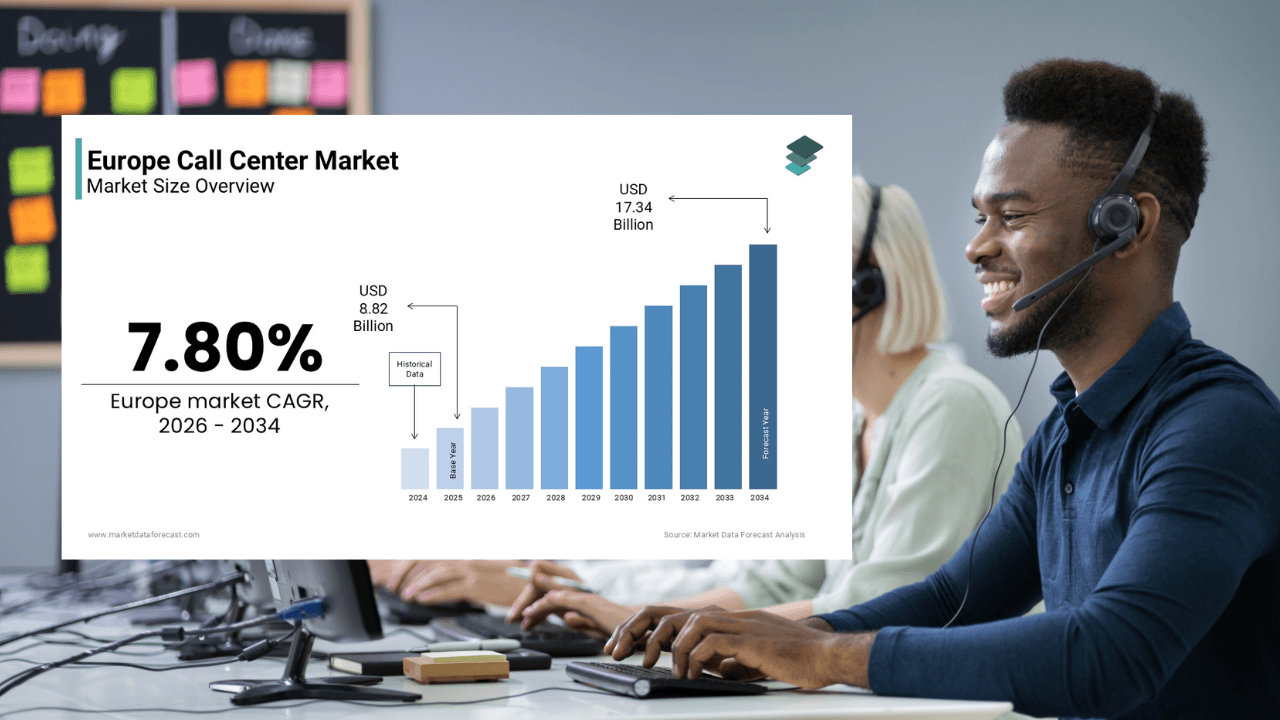
- Europe’s call center industry grows from $9.51 billion to $17.34 billion
- That runs through 2034 at a 7.80% compound annual growth rate
- Over 65% of EU consumers switch after two poor service experiences
- Outsourcing can decrease operational costs by 25%
BRUSSELS, BELGIUM — The Europe call center industry is set to nearly double in value over the next decade from US$9.51 billion in 2026 to US$17.34 billion by 2034 with a compound annual growth rate (CAGR) of 7.80%, driven by rising digital demand, artificial intelligence (AI) integration, and strategic outsourcing.
This growth highlights the region’s transformation into a sophisticated customer experience ecosystem where voice, messaging, and AI-powered interactions are central to enterprise-consumer engagement.
Digital-first consumers drive omnichannel customer service
According to a recent industry report from Market Data Forecast, European consumer expectations experience fast changes at the present time. Modern customers require businesses to provide instant and continuous support through multiple digital channels while they consider any delay or broken service delivery system to be unacceptable.
The European Consumer Organization found that over 65% of consumers in the EU would switch to a competitor after just two instances of poor service.
Conversely, the European Retail Round Table reported that retailers implementing genuine omnichannel approaches experienced 30% growth in customer loyalty scores and 20% decrease in customer churn rates.
The proliferation of smartphones and high-speed internet has made messaging apps like WhatsApp as preferred support channels.
According to Eurostat data cited in the forecast, enterprises that fail to unify communication streams will lose market share to competitors who deliver smooth digital communication for their customers.
The rising digital inquiries problem worsens as 82% of EU residents used the internet for public services or purchases in 2023 alone.
AI integration and call center outsourcing trends
To meet these demands, European businesses are increasingly outsourcing non-core customer interactions to specialized providers.
“Large corporations in Western Europe expanded their outsourcing contracts in 2023, specifically to leverage the scalability and cost efficiencies offered by external partners,” said the European Outsourcing Association.
Outsourcing not only decreases operational costs by 25% throughout the year but also enables companies to hire international professionals while using cutting-edge AI tools.
The implementation of generative AI technology will improve call center operations by providing real-time assistance to agents who need help with response writing and content creation. The tools enable workers to spend time on essential tasks that require human compassion while delivering faster and more precise services.
Simultaneously, nearshore hubs in Eastern and Southern Europe—including Poland, Romania, and Bulgaria—are emerging as cost-effective alternatives, providing multilingual talent aligned with EU regulations.
This trend is strengthening the outsourcing ecosystem, enabling businesses to scale efficiently while maintaining service quality.
Moving forward, the European call center industry expansion shows its evolution through the combined use of AI and strategic outsourcing methods. Companies that adopt both technological advancements and flexible workforce solutions will achieve market leadership, whereas businesses that fail to keep up will struggle with customer expectations and operational complexity.
Related news
- Kenya opens first AI-powered BPO hub to boost youth digital jobs · 14 Mar
- Philippine BPOs seek expanded WFH as global fuel costs rise · 13 Mar
- AI shift could cut millions of Indian BPO jobs by 2030, analysts warn · 13 Mar
Disclosure: Outsource Accelerator uses AI tools in the backend of its editorial workflow. Every article is reviewed and verified by a human editor before publication.
Stay ahead of the outsourcing industry. Join thousands of business leaders who rely on Outsource Accelerator for the news, trends, and expert insights that matter. Subscribe to our free newsletter and never miss an update.








