
Simply Contact urges to rethink of luxury e-commerce CX support

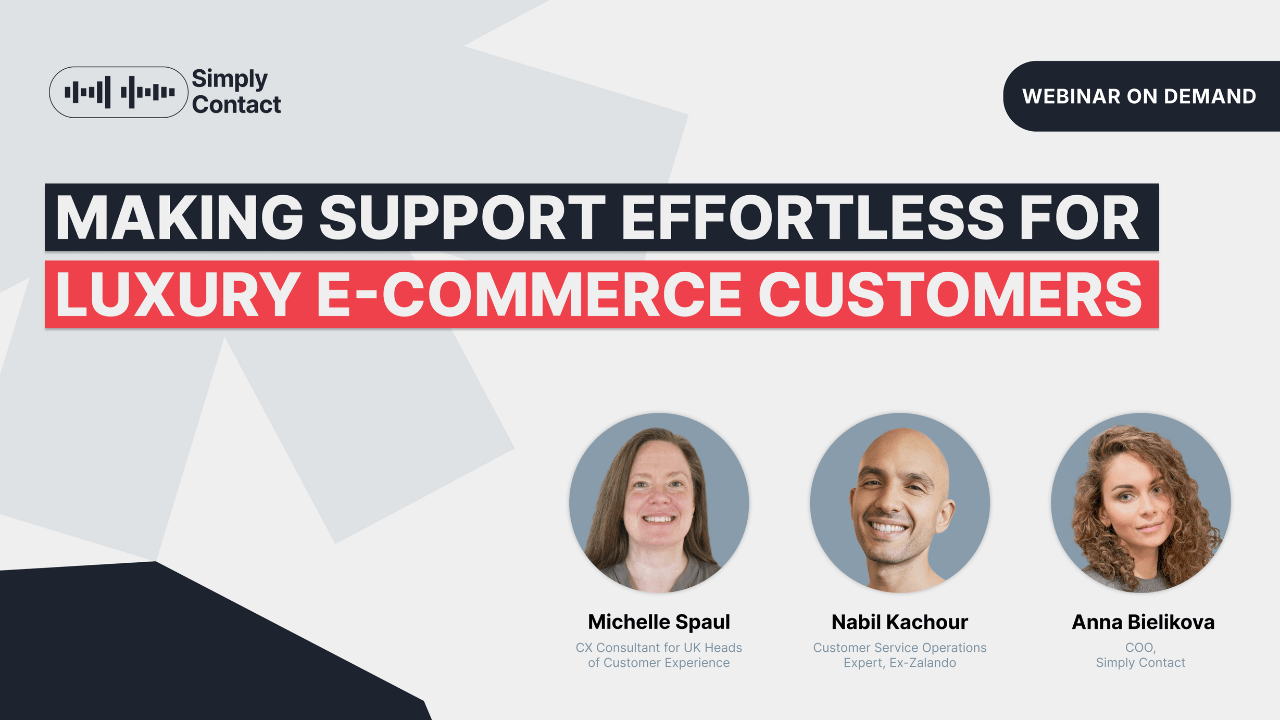
WARSAW, POLAND — Luxury e-commerce brands must rethink how they handle customer support, shifting away from speed-driven models toward more personalized, low-effort experiences.
Industry practitioners at the discussion said many premium brands risk undermining their own value proposition by relying on support systems designed for mass-market efficiency rather than high-touch engagement.
As luxury customers expect to feel “known, valued, and looked after,” even minor service failures can erode trust and drive long-term churn.
Why customer effort score matters more than speed
According to a recent panel hosted by outsourcing firm Simply Contact, panelists emphasized that speed alone is no longer a reliable measure of quality in customer experience. Instead, they pointed to Customer Effort Score (CES) as a more accurate indicator of loyalty and satisfaction.
“The biggest driver of customer disloyalty isn’t really a bad experience, but it’s the effort,” said e-commerce operations expert Nabil Kachour.
“The harder a customer has to work to get that problem solved, the more likely they are to leave,” Kachour added.
Kachour noted that even efficient interactions can fail if customers are forced to repeat information or follow up multiple times. In luxury, where purchases are often tied to emotion and identity, this friction can quickly break the brand connection.
“A delayed or damaged order becomes a logistics problem, when it should be treated as an emotional event,” he added, pointing to gaps in post-purchase communication and returns processes.
Michelle Spaul, a UK-based CX consultant who moderated the session, said luxury brands must “work at the pace of the customer,” balancing efficiency with a deeper, more intuitive form of service. “It’s not just about effectiveness—it’s about that feeling of being known and not having to try,” she said.
Build smarter CX systems before scaling support teams
The panel also challenged the common approach of scaling support teams by hiring more agents. Instead, speakers urged companies to focus on system design, mapping customer needs to the right channels, and response strategies before increasing headcount.
“You can’t hire your way to effortless support—you need to design your way there,” Kachour said, stressing the importance of aligning service channels with customer intent and emotional context.
Automation, panelists agreed, should be used selectively and remain largely invisible to customers.
“Automation in luxury works when the customer doesn’t notice it,” Kachour said, adding that it should remove friction rather than replace human interaction.
Anna Bielikova, COO at Simply Contact, highlighted the importance of agent training and emotional intelligence in delivering premium service.
“We are looking into the emotional intelligence of the agents… and how we deliver when the customer feels that he is the only one,” she said.
As outsourcing providers like Simply Contact position themselves as strategic partners in customer experience, the discussion signals a broader shift in the industry.
Rather than competing on cost and efficiency alone, outsourcing firms are increasingly expected to deliver high-value, insight-driven support models—particularly in sectors like luxury e-commerce, where customer loyalty is fragile, and every interaction carries long-term commercial impact.
Related news
- Conectys shifts from BPO to BTO with global four-talent model · 27 Mar
- AI to transform Jamaica’s BPO sector, protect jobs — state minister · 11 Mar
- AI takes CX mainstream in 2026, Simply Contact whitepaper shows · 5 Mar
Disclosure: Outsource Accelerator uses AI tools in the backend of its editorial workflow. Every article is reviewed and verified by a human editor before publication.
Stay ahead of the outsourcing industry. Join thousands of business leaders who rely on Outsource Accelerator for the news, trends, and expert insights that matter. Subscribe to our free newsletter and never miss an update.








