
AI job losses in U.S. fuels calls for universal basic income, AI tax

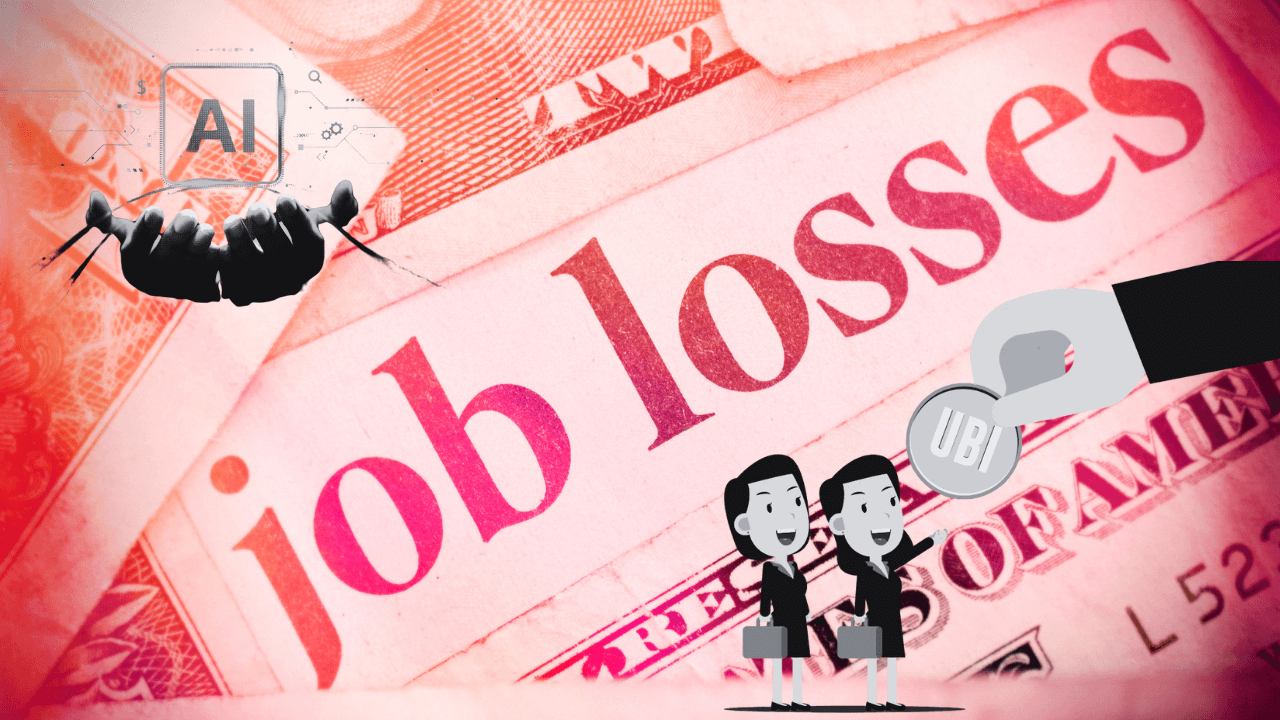
GEORGIA, UNITED STATES — As artificial intelligence (AI) rapidly displaces workers across major industries in America, the concept of universal basic income (UBI) is gaining traction. Following a successful local pilot program, Cook County, Illinois has committed millions to a guaranteed income initiative.
At the same time, former U.S. presidential candidate Andrew Yang argues that taxing AI firms could fund a solution to mitigate widespread job loss.
AI-driven job losses accelerate across major industries
Several recent research and company reports cited by CNN estimate the short-term and long-term effects of AI and automation on jobs.
A study by Massachusetts Institute of Technology (MIT) concludes that AI currently has the capacity to replace 11.7% of the American workforce, potentially impacting salaries of up to $1.2 trillion across major industries.
Companies such as Amazon, Salesforce, Walmart, and Meta have announced AI-related layoffs, bringing the total to approximately 1 million in the country.
In the outlook, the forecasts have become worse. According to the McKinsey Global Institute, 40% of American jobs will be displaced by AI by 2030, and 92 million positions worldwide will face a threat, according to the World Economic Forum.
Andrew Yang quotes that 44% of American jobs can be automated. He extends this to the possibility of losing 30 to 40 million jobs within the next decade, a situation he describes as “devastating” and “catastrophic” for communities.
U.S. guaranteed income pilots test basic income at scale
Local action in the UBI theoretical discussion is being piloted most notably by Cook County, Illinois. In its 2026 budget, the county board unanimously voted to fund a guaranteed basic income program of $7.5 million, permanently expanding the pilot that gave 3,200 households $500 per month.
This pilot data demonstrated measurable improvements: 94% of beneficiaries used the funds to address financial crises, three-quarters felt more confident in their finances, and 70% said it positively affected their mental health.
This local initiative renews the national policy debate, led by figures such as former presidential candidate Yang, who proposed a $1,000-a-month freedom dividend. According to its supporters, UBI offers a steady option during the shift to technology.
However, critics, such as the Illinois Policy Institute, contend that such programs reduce work experience and earnings, highlighting the ideological divide over using direct cash payments as a remedy for structural job loss.
Moreover, the Godfather of AI, computer scientist and Nobel physics laureate Geoffrey Hinton, previously noted that while a universal basic income fails to address the human dignity lost with work, the exact AI-driven wealth concentration and job displacement he forecasts are the very forces propelling UBI from theory into urgent policy debate.
“It’s going to create massive unemployment and a huge rise in profits. It will make a few people much richer and most people poorer. That’s not AI’s fault, that is the capitalist system,” Hinton told the Financial Times.
This situation mirrors what Yang described as a necessary adaptation of capitalism, where he argued that “If you shove millions of Americans to the curb via AI and automation, then they’re not going to be able to go to their local business. They’re not gonna be able to meaningfully grow the economy.”
Andrew Yang pushes AI tax to fund universal basic income
A central challenge to implementing UBI at scale is funding. A prominent proposal emerging from the debate is taxing the AI industry itself.
Yang points to Anthropic Chief Executive Officer (CEO) Dario Amodei, suggesting that AI firms should be taxed, noting that “hundreds of billions of dollars of value” are being realized by these companies, partly built on publicly sourced data. Yang suggests an “AI tax” or “compute tax” to generate substantial revenue for programs like UBI.
This approach aims to redistribute the concentrated gains from AI. Yang points out that at the current level of U.S. GDP per person, it is approximately $85,000.
He explained that, “Regardless of whether AI as an investment thesis is a little bit overhyped, you know that it’s going to have a positive effect on GDP. So if you have $85,000 ahead, then having $12,000 a year, which I proposed in 2020, actually seems pretty modest and reasonable.”
He discusses the issue of market volatility, including the possibility of a tech bubble burst, by arguing that funding must be stable regardless of a firm’s particular value, making UBI a stabilizing force in an ever-more automated consumer economy.
The looming wave of AI-driven displacement is forcing a fundamental renegotiation of the social contract, with localized UBI pilots providing a proof of concept and suggestions like an “AI tax” emerging as contentious yet pivotal mechanisms to redistribute technological gains and stabilize the future economy.







