
Global call center outsourcing market to hit $198.9Bn by 2032: MMR

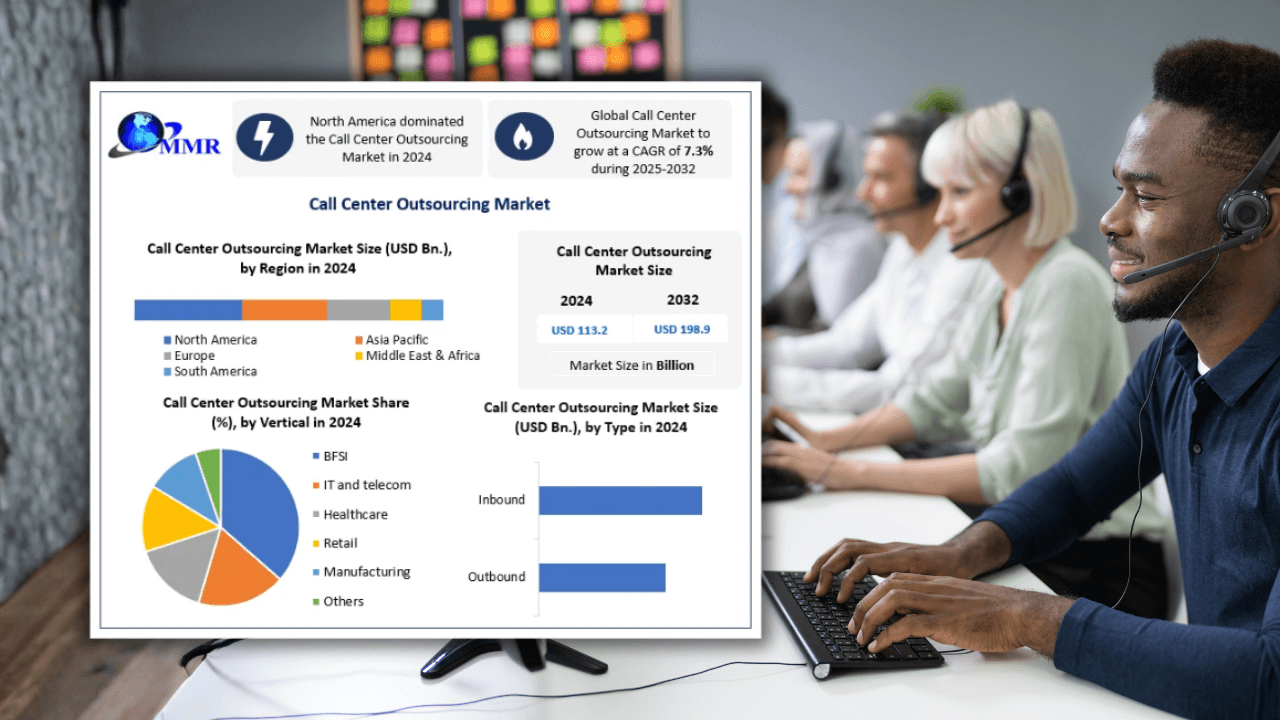
PUNE, INDIA — The global call center outsourcing market is set to reach US$198.9 billion by 2032, roughly doubling from US$113.2 billion in 2024 at a compound annual growth rate (CAGR) of 7.3%, according to a study by Maximize Market Research (MMR).
This significant expansion is fueled by the adoption of artificial intelligence (AI), multichannel customer service, and an increasing global demand for personalized, rapid support.
“The adoption of artificial intelligence, chatbots, robotic process automation, and predictive analytics is reshaping customer interactions,” the MMR report said.
AI and automation drive call center growth
The research revealed a number of main factors that were responsible for the increase in the market. One of the main drivers is outsourcing, which enables companies to cut down on costs, increase their operations, and get access to specialized knowledge.
Businesses can also provide 24/7 support across time zones while focusing on primary business functions.
Call centers no longer work only with voice support but also with the integration of email, chat, social media, and video interactions. Conversely, the rising global need for fast and tailored service, along with local support, has been one of the key factors contributing to the expansion of the areas that have already established their outsourcing infrastructure.
North America is still the leading market with a share of over 32%, while the Asia-Pacific market, which includes countries such as India, the Philippines, and Malaysia, is anticipated to be the fastest-growing region.
The regions of Europe, South America, and the Middle East and Africa are turning out to be the most appealing nearshore destinations mainly because of their language proficiency, lower costs, and advantageous geographic position.
Outsourcing trends, opportunities in omnichannel and analytics
The market is opening up new opportunities with the increase of omnichannel support, AI customer analytics, and the recruitment of people speaking different languages. Moreover, outsourcing could be a smart move for firms to mitigate operational risks and improve service quality at the same time.
Nonetheless, the industry is confronted with a number of problems to tackle, like distrust of data security, varying levels of service quality, languages and cultures impeding communication, and a high rate of employee turnover.
The MMR report mentioned that businesses are tackling these matters by means of vendor governance, performance monitoring, cybersecurity frameworks, and enhancements in workforce experience.
The integration of AI, customer engagement through multiple channels, use of data analytics, adherence to regulations, and employee retention tactics are major factors that are shaping the trends in the industry.
Service providers adopting these innovations are able to deliver faster, smarter, and more personalized experiences.
As digital-first customer engagement becomes a priority, the call center outsourcing market exemplifies how technology and global talent are redefining service delivery.
The companies that synchronize their outsourcing strategies with AI innovation, putting the customer first, and ensuring data security are likely to obtain long-term value, illustrating the strategic necessity of outsourcing not only for cost efficiency but also as a source of competitive advantage in a fast-changing global market.







