
EU working life duration reaches 36.9 years in 2023

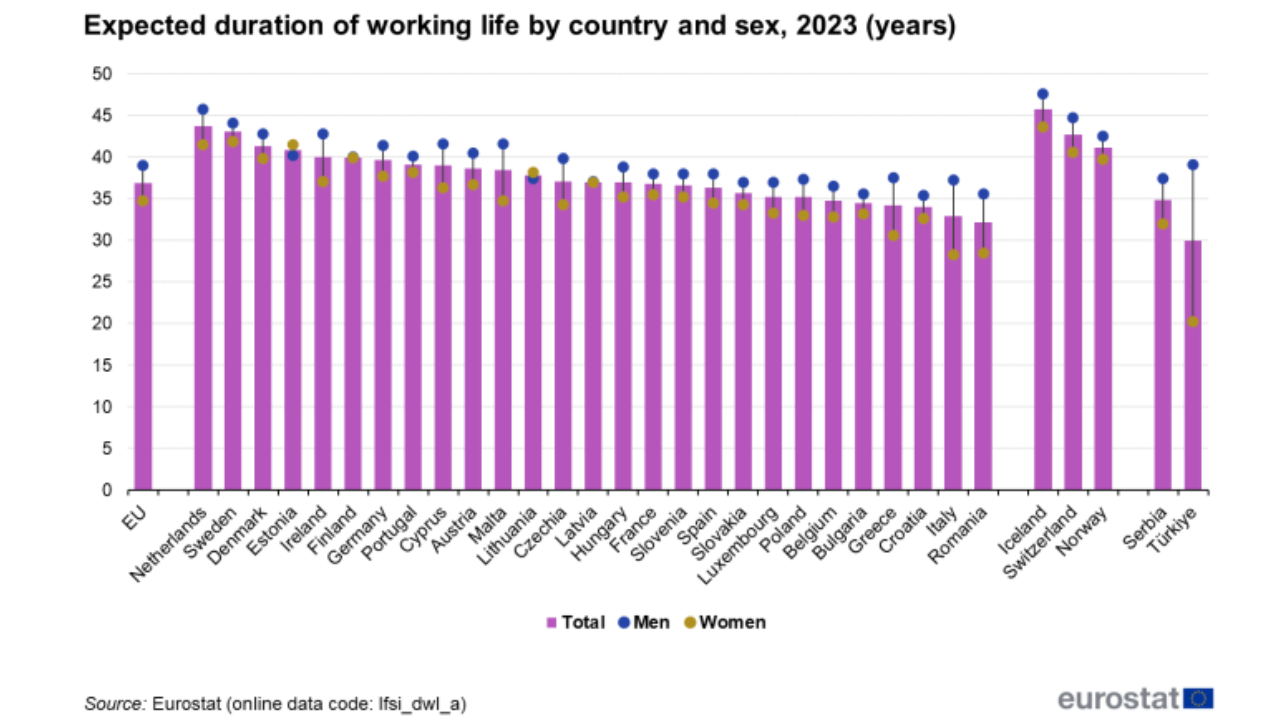
BRUSSELS, BELGIUM — The European Union’s (EU) average working life duration reached 36.9 years in 2023.
This figure represents the period a 15-year-old is expected to be active in the labor market. It reveals variations across member states and between genders.
Netherlands leads, Southern Europe lags
The Netherlands led the EU with an average working life of 43.7 years, followed closely by Sweden (43.1 years) and Denmark (41.3 years). These northern European countries consistently outperformed the EU average, with all three exceeding the 40-year mark.
According to recent data from Eurostat, in contrast, some southern and eastern European countries recorded the shortest working lives. Romania reported the lowest average at 32.2 years, with Italy (32.9 years) and Croatia (34.0 years) also at the lower end of the spectrum.
Shifts in working life duration across the EU
The report indicated that, except for Romania, all EU countries experienced an increase in the expected duration of working life between 2013 and 2023.
Hungary, Malta, Ireland, Estonia, and the Netherlands showed the most significant gains. Malta’s increase was particularly notable, driven by a sharp rise in women’s expected working life.
In contrast, countries like Spain, Germany, and Austria saw relatively stable figures, with increases of less than two years.
Romania was the only EU country to record a decline, primarily due to a decrease among women.
Gender gap persists, but narrowing
On average, men in the EU are expected to work for 39.0 years, with the Netherlands topping the list at 45.7 years.
On the other hand, women in the EU averaged 34.7 years, with the longest durations observed in Sweden (41.9 years), the Netherlands, and Estonia (both 41.5 years).
However, this gap appears to be narrowing in most EU countries. This trend was particularly pronounced in Malta, which saw the largest gain in women’s expected working life at 8.9 years.
The trend towards longer working lives appears set to continue, with implications for retirement policies, workforce planning, and social security systems across the EU.
Related news
- HR leaders expect more remote work in 2024 – HireRight · 1 Aug
- Taiwan launches digital nomad visa to boost tourism, economy · 1 Aug
- AI to transform 92% of tech jobs, industry giants call for upskilling · 2 Aug
Disclosure: Outsource Accelerator uses AI tools in the backend of its editorial workflow. Every article is reviewed and verified by a human editor before publication.
Stay ahead of the outsourcing industry. Join thousands of business leaders who rely on Outsource Accelerator for the news, trends, and expert insights that matter. Subscribe to our free newsletter and never miss an update.








