
U.S. workforce ages as firms seek experience, Revelio Labs study finds

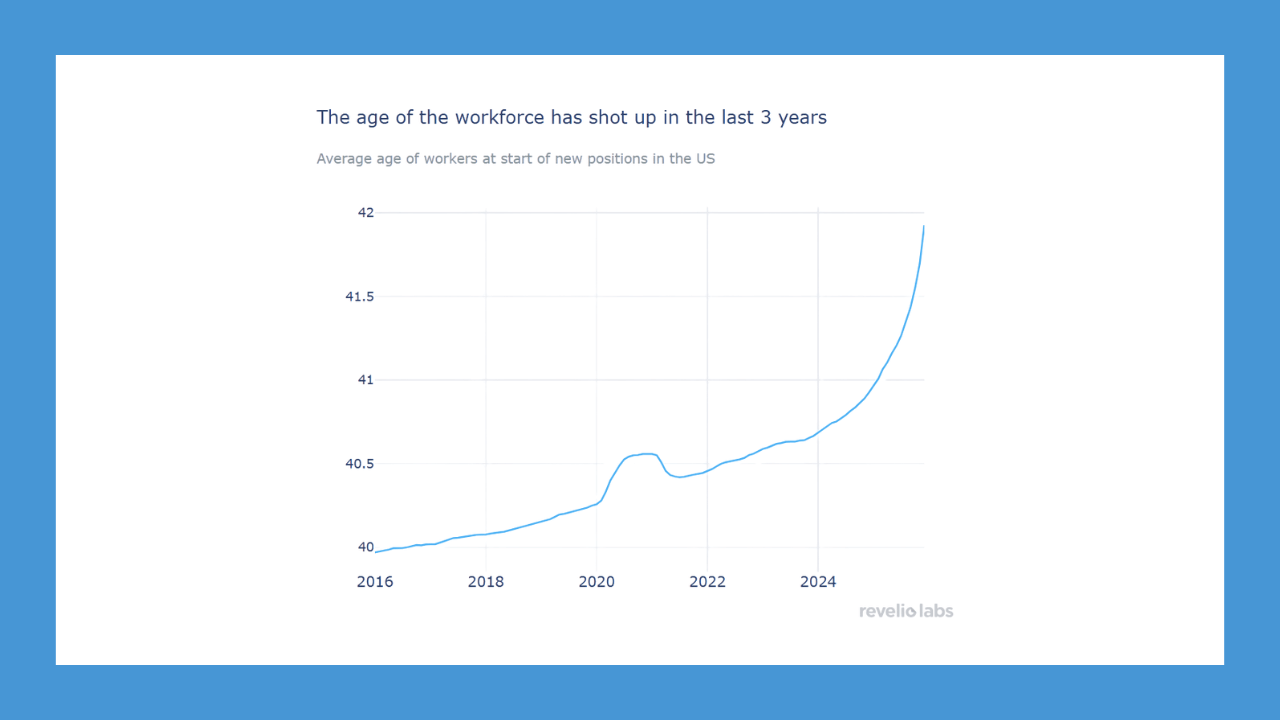
NEW YORK, UNITED STATES — The average age of workers starting new jobs has risen sharply since 2022, defining a profound shift in hiring patterns.
Revelio Labs reports that this change is driven by older employees re-entering or remaining in the workforce. At the same time, younger workers face diminished entry opportunities, signaling a more conservative, selective labor market.
Economic cycles drive hiring conservatism
Organizations have grown more conservative in this setting, with their attention on short-term productivity and role preparedness.
This trend is evident in the increase in the average age of position start, which rose significantly after 2022 to more than 42 years as of 2025. This is contrary to the general trend of late-cycle expansion, in which tight labor markets absorb younger workers.
Instead, the current cycle reveals an active but increasingly selective market, decisively tilted toward experienced candidates, fundamentally reshaping who secures new opportunities.
As the report notes, “When growth is abundant, firms are more willing to hire for potential and train workers on the job. When growth slows, hiring does not disappear; it becomes more conservative.”
“Experience, immediate productivity, and role readiness suddenly begin to matter more, making older workers comparatively attractive.”
Service and people-facing roles see sharpest aging
The aging trend is not due to a shift toward industries that inherently employ older workers but is happening almost entirely within occupations.
The report notes, “Entry-level hiring has weakened across much of the economy, while older workers have become more willing to stay in the labor force or return after retirement. Together, those forces raise the average age even if the underlying occupational composition barely changes.”
This professional stability highlights that it mainly stems not from economic transformation but from employment incentives.
This interpretation is further evidenced by the roles that have been changing at the fastest pace since 2015, concentrated in service- and people-facing roles.
Occupations such as service operations, sales representatives, claims adjusters, office assistants, and real estate agents have been experiencing an average age increase of about 3 years because these jobs offer high rewards for accumulated experience, interpersonal judgment, and institutional networks.
Comparatively, technical areas such as data analysis have been much less mature, or even becoming younger, noting an increasing occupational differentiation in the employment of experienced skills and the importance of safe, formal training.
This decisive pivot toward experienced hires establishes a new equilibrium in the labor force, one that prioritizes immediate productivity over potential and risks cementing a generational reallocation of opportunity that will define the workforce for years to come.







