
Growth optimism amid cyber, AI, talent fears: global exec survey

CALIFORNIA, UNITED STATES — A global survey reveals corporate leaders are strategically balancing significant growth optimism with acute concerns over cybersecurity, AI integration, and a deepening talent crisis.
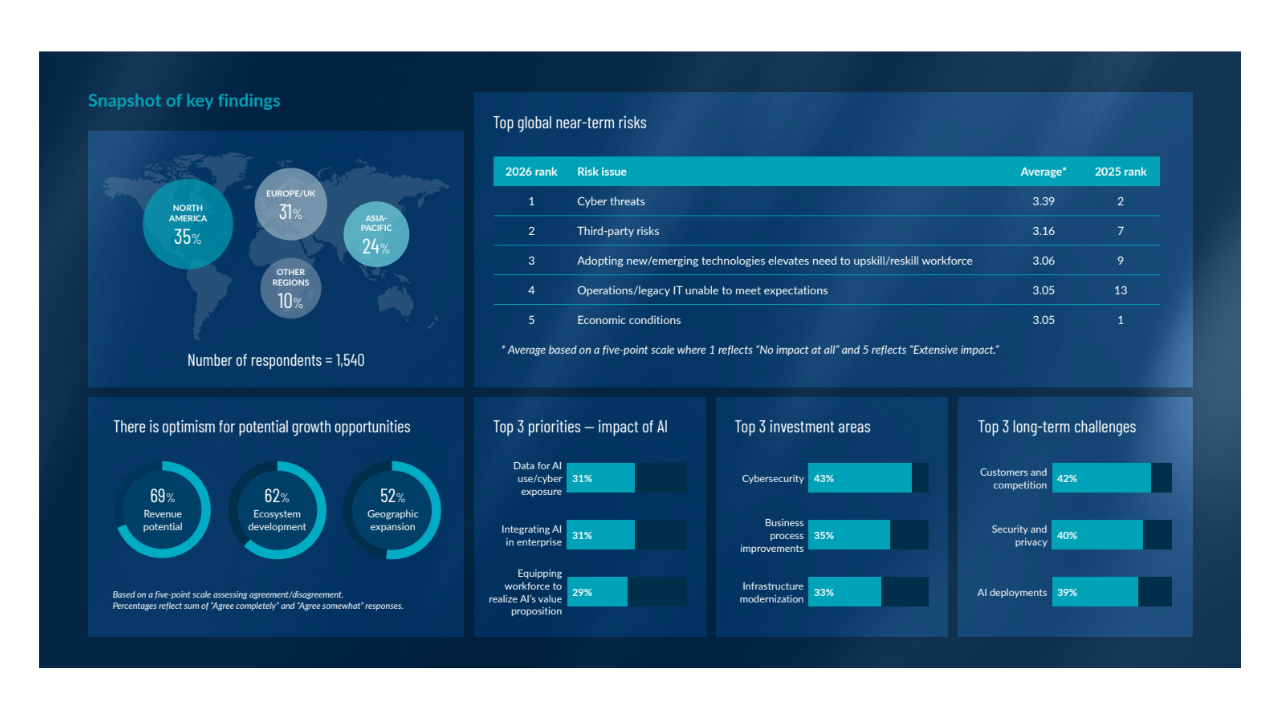
The 2026 “Executive Perspectives on Top Risks and Opportunities” report, released by consulting firm Protiviti and NC State University’s ERM Initiative, captures insights from 1,540 board members and C-suite executives worldwide. The online survey, which ran from early September to mid-October 2025, revealed a business environment that inherently links opportunity and risk.
Fran Maxwell, Protiviti’s Global Leader, notes, “HR functions and organizations are going to have to redesign jobs. That’s not necessarily a muscle that most functions have.”
Cybersecurity, AI top strategic investment priorities
This leadership highlights a shift in which digital defense is no longer a back-office challenge but a frontline strategic necessity of paramount importance to brand image and business sustainability.
The survey shows that 42% of leaders rank cybersecurity as their top strategic investment priority over the next two to three years, as it is now recognized as a non-negotiable fiduciary and operational requirement.
Tightly linked to it is the accelerated development of AI, which poses transformative opportunities and multidimensional new threats. The sixth-highest near-term risk is AI, and executives are especially worried about the dangers it poses.
The two main AI-related concerns are data security when using AI (31%) and the difficulty of harmonizing AI and current technologies and working processes (31%).
This points to a significant contradiction: the urge to use AI as a competitive advantage simultaneously increases the attack surface, leaving cybersecurity and AI governance strategies as the only options.
AI automation deepens talent crisis
The issues associated with talent are on the agenda of executive thinking, but in a changing form. Among the top ten near-term risks are the need to upskill and reskill the workforce due to new technologies and the expansion of a skilled workforce.
The influence of AI is accelerating this change, transforming the recruitment process into an urgent demand for strategic reskilling and role redesign to exploit AI’s opportunities.
A key insight from associated expert discussions notes that AI is automating traditional entry-level “grunt work,” potentially eroding the foundational pathway for developing future mid-level strategic thinkers and critical experts.
Consequently, human capital management is a major strategic investment priority, ranked sixth overall. For Chief Human Resources Officers (CHROs), it is the top priority.
The survey results and the experts’ analysis lead to a sad conclusion: organizations cannot resolve tomorrow’s strategic challenges with yesterday’s talent models.
The critical bottleneck is investment in workforce skilling, which will define the payoff on investments in technology and process enhancements. A fundamental redesign of work and career paths is necessary to develop the capabilities to survive in the future.
Ecosystem partnerships outpace geographic expansion
Executives express strong optimism for revenue growth (69%) but are strategically selective in their expansion approaches.
The development of strategic alliances and partnerships, or ecosystem expansion, is a major priority, with 62% of leaders identifying it as a significant opportunity.
This approach is viewed as a powerful enabler of co-innovation, data sharing, and market reach that would be difficult for any single organization to achieve on its own.
“While AI is seen as a transformative growth enabler, IT infrastructure and talent readiness present major barriers to its effective deployment and realizing its full benefits,” the report notes.
Geographic expansion into a new foreign market, in contrast, is considered more cautiously, with just 52% agreement. This quenched euphoria demonstrates the fear of the trade policy, the geopolitical crisis, and the complication of the regulatory framework.
The results indicate a strategic choice to use digital platforms and ecosystems as the driving force for growth, which does not require physical expansion of the footprint in the near future.
It means there is a subtle growth plan that requires creating resilient, closely tied networks rather than pursuing large-scale global diversification, which is uncertain in the current international environment.
The report concludes that “The most successful organizations will be those that treat opportunity and risk as interdependent forces — embedding agility, foresight, and cross-functional collaboration into the core of their strategic agenda.”
The executive agenda for the future of work now demands a strategic choreography of cyber-resilient AI integration, profound talent model reinvention, and ecosystem-led growth—a triple mandate in which success in any one hinges on synchronous advancement across all three to achieve future-proof growth.







