
Healthcare IT outsourcing to double, hit $153Bn by 2034: Market.us

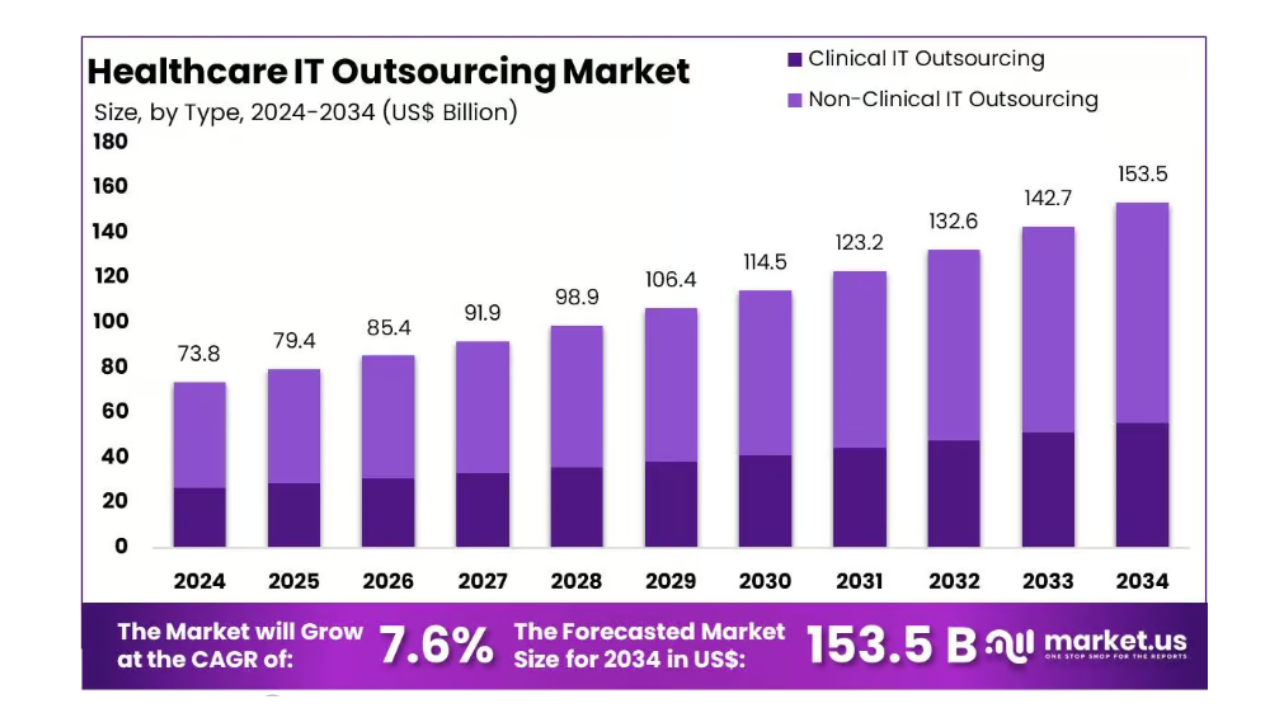
NEW YORK, UNITED STATES — The global healthcare IT outsourcing market is poised for significant expansion, projected to grow from $73.8 billion in 2024 to $153.3 billion by 2034, according to an industry report by Market.us.
The growth, driven by digital transformation and cost pressures, is fundamentally reshaping how healthcare organizations manage their technology and operational needs.
Digital health adoption drives outsourcing
The convergence of widespread digital health adoption and complex regulatory mandates is generating steady, multi-year outsourcing contracts. Over 129 countries have now adopted national digital health strategies, creating resilient program budgets for building identity, consent, and data-exchange capabilities.
This is complemented by specific, large-scale technical requirements; under the United States CMS Interoperability and Prior Authorization Rule, players must implement specific FHIR APIs, a complex task commonly outsourced to specialized engineering partners.
The sheer scale of existing digital infrastructure, which necessitates ongoing management, further solidifies this demand. Approximately 96% of non-federal acute care hospitals and 78 percent of office-based physicians in the U.S. use certified electronic healthcare records (EHRs), resulting in significant integration, upgrade, and support workloads.
Moreover, as interoperability networks continue to grow, such as TEFCA, which involves thousands of exchanging organizations, external support in testing and maintenance is a pillar, by definition, of outsourcing.
AI and analytics fuel new opportunities
Healthcare organizations are increasingly outsourcing to access specialized AI and data analytics capabilities they cannot build in-house. An HIMSS-Medscape report found 86% of health systems already use AI, with 60% valuing it for pattern detection beyond human ability.
This creates a booming demand for outsourced services related to data annotation, model validation, and managing the complex data pipelines required to fuel these advanced applications.
To a great extent, providers and payers seek external vendors to assist in engineering, mapping, and maintaining these application programming interface (API) systems, providing both a means of translating all this data into useful intelligence and creating a vast new source of outsourcing revenues.
Cybersecurity risks boost demand for MSSPs
The primary restraint on market growth—data security risk—is ironically becoming a key opportunity for specialized outsourcing vendors. The healthcare sector is disproportionately targeted, with 725 large breaches reported in 2024 exposing 275 million records.
The financial cost is astronomical, considering that the average price of a healthcare data breach in 2024 is $9.77 million.
This presents 24/7 monitoring, hardening, and incident-response services provided by managed security service providers (MSSPs) as not just an optional service but a necessity, where a market restraint becomes a driver of a specific outsourcing niche.
Similarly, the immense complexity of system integration and regulatory compliance is bolstering demand for vendors with specific expertise. Although interoperability is an objective, a national survey revealed that 57% of digital health companies are currently using a chaotic set of incompatible APIs, with almost half stating that they face excessive access costs as an obstacle.
Navigating this terrain while also complying with stringent policies, such as the General Data Protection Regulation (GDPR) and Health Insurance Portability and Accountability Act (HIPAA), is a core competency of established healthcare IT outsourcing vendors.
Their postings of ready-made, compliant products, along with the administration of complex vendor environments, help clients tackle these challenging obstacles and ensure a market performance increase despite the challenges.







