
One in 10 jobs in rich nations now demands AI-era skills, IMF reports

WASHINGTON, UNITED STATES — One in 10 jobs in advanced economies now requires at least one new, artificial intelligence (AI)-era skill, signaling a rapid shift in global hiring standards and labor markets, a new International Monetary Fund report shows.
While workers with these skills command higher wages, the transition risks displacing middle-skill roles and suppressing entry-level hiring, underscoring an urgent need for proactive policy to manage the disruption and share AI’s gains.
“New skills, new tasks, and entirely new occupations are being created alongside automation, offering alternative pathways for prosperity,” the report notes.
Tech-centric roles dominate demand
A study of millions of online vacancies indicates that the most sought-after jobs are professional, technical, and managerial, and that IT skills alone have been required for more than half of the new vacancies.
The capabilities are also becoming more sector-specific, such as the boom in telecare in healthcare and in social media expertise in marketing.
This change is generating anxiety on an enormous scale, and almost 40% of all the jobs in the world are being driven by AI. For workers, employability is increasingly linked to the ability to refresh or acquire skills.
The statistics show an obvious gap: every 10 job advertisements in developed economies and every 20 in developing nations today demand at least one of the new skills, which form a new standard of workforce preparedness.
The report notes that their findings “underscore the need for proactive and comprehensive policymaking that prepares the labor force for the future of work and ensures the gains from AI are broadly shared.”
The AI wage premium and employment gap
The tangible premium is on emerging skills, and the potential upside for adaptable workers is that employers are willing to pay them.
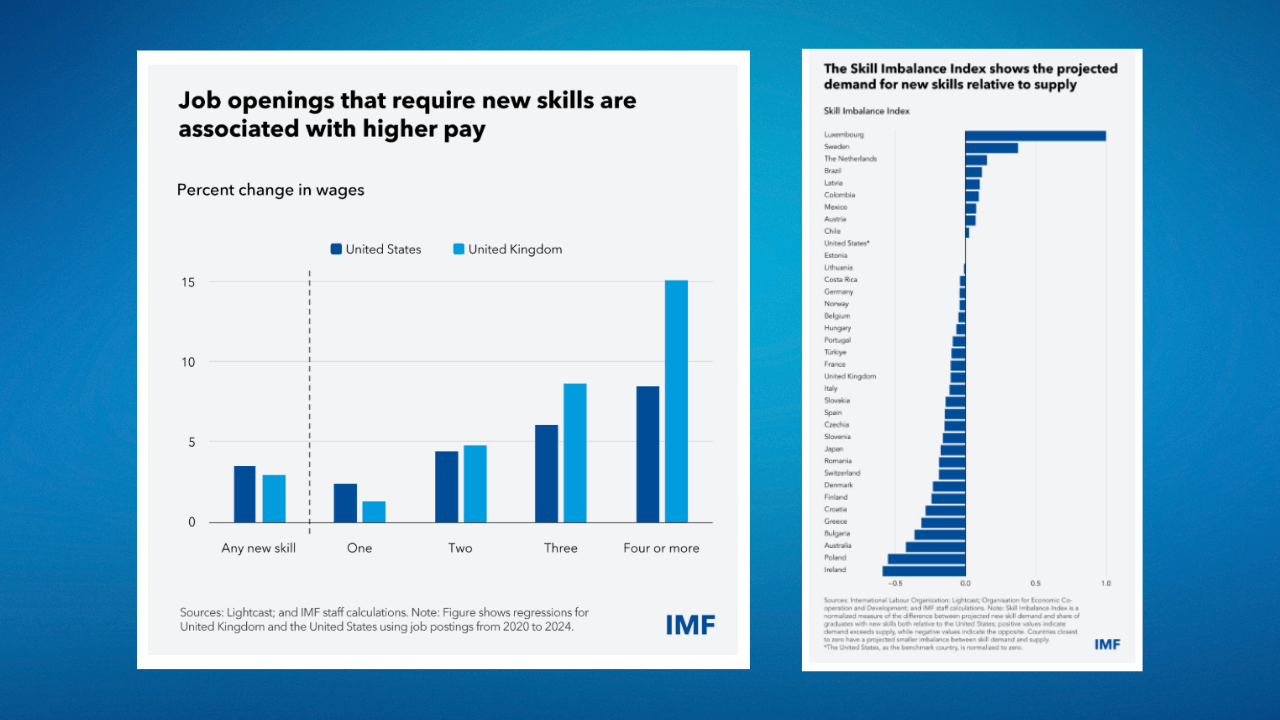
In the United Kingdom and the United States, job advertisements that include a new skill receive a pay raise of between 3% or more, with the premium soaring to 15% in the UK and 8.5% more in the U.S.
This spending power can boost local economies, and U.S. regions have seen employment grow by 1.3% for every percentage-point increase in new-skill job adverts over the last 10 years.
The benefits, however, are not evenly spread. Middle-skill jobs, such as routine office work, are being compressed, whereas high- and low-skill workers are reaping more.
The picture for AI-related skills is particularly complex; they command high wages but have not fueled employment growth.
In fact, regions with high demand for AI skills have seen employment in AI-vulnerable occupations fall by 3.6% after five years, compared to regions with lower demand, posing a significant challenge for young job seekers as entry-level roles are highly exposed to automation.
Global policy: Bridging the skills divide
The asymmetric effect of technological change is not inevitable; it depends on policy decisions. The IMF has a Skill Imbalance Index that serves as an indicator of future skill demand and supply, classifying countries and providing information to inform action.
Countries such as Brazil, Mexico, and Sweden that face high demand but limited supply of new skills will be forced to invest in education systems and training, and they may have to depend on immigration of skilled people.
On the other hand, nations with abundant talent and low demand, such as Australia, Ireland, and Poland, require policies to boost innovation and help companies absorb talent.
Wider suites of policy are necessary towards adaptation. The report suggests that policies must be put in place to help workers acquire skills and increase mobility by providing affordable housing and flexible work arrangements.
Competition policy is essential to prevent market concentration, as firms compete for limited talent, which may kill innovation. Additionally, social protection mechanisms should be strengthened to facilitate job transitions.
The report also notes that education should be redesigned to promote cognitive and creative capabilities to supplement AI and to support sturdy investment in lifelong learning, a characteristic feature of high-ranking economies such as Finland, Ireland, and Denmark in the IMF Skill Readiness Index.
“Success will hinge on bold steps taken now: investing in skills supporting workers through job transitions and keeping markets competitive so innovation benefits everyone,” the report concludes.







