
North America LPO market to hit $52Bn by 2033: Market Data Forecast

ANDRHA PRADESH, INDIA — The North American legal process outsourcing (LPO) market is on a trajectory for explosive growth, driven by overwhelming regulatory complexity and a surge in litigation.
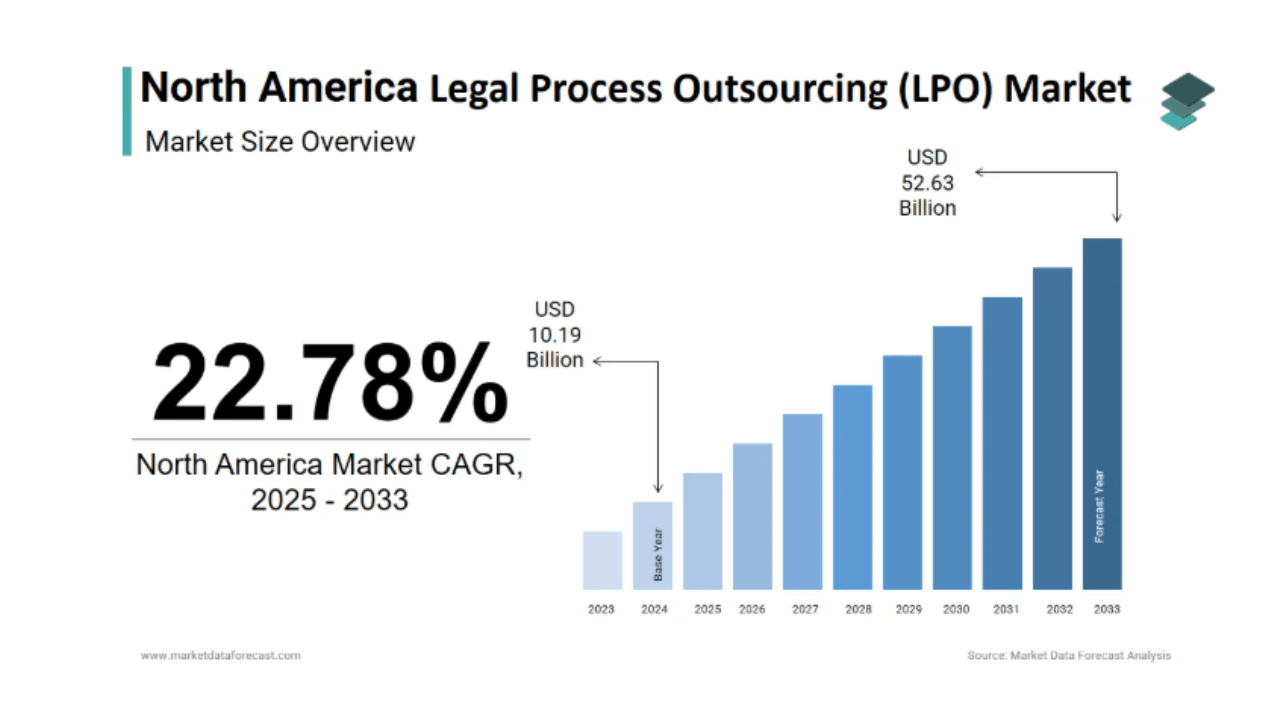
According to a report by Market Data Forecast, valued at $10.19 billion in 2025, the market is projected to reach $52.63 billion by 2033, expanding at a formidable compound annual growth rate of 22.78% as law firms and corporations increasingly turn to external providers for cost-effective, tech-enabled legal support.
Compliance pressures drive legal outsourcing boom
Companies are collapsing under the burden of the complicated compliance requirements, and the average Fortune 500 organization has had to deal with more than 1,200 regulatory demands in each year of its existence.
This has seen 74% of United States in-house legal departments outsource compliance work, as in-house teams cannot monitor and report continuously. Furthermore, in 2022, financial institutions submitted over 2.3 million specific activity reports, which are so voluminous that they necessitate legal discussion. Specialized LPO companies, equipped to handle such high volumes, are increasingly taking over this discussion.
The U.S. court system is simultaneously generating an insatiable need for litigation support. More than 333,000 civil case filings were received at federal courts in 2022, with a significant part of them having colossal amounts of electronic evidence.
The typical mid-sized litigation case presently encompasses more than 1.8 million documents to be reviewed, an activity that is too costly to undertake in-house.
This is exacerbated by the emergence of sophisticated multi-district litigation (MDL), with more than 4,000 active in 2023, each requiring centralized coordinated document management across jurisdictions, requiring an LPO provider with unique experience and capability.
AI transforms LPO from cost-saver to strategist
AI integration is the primary force enabling LPO providers to manage the enormous scale of modern legal work. Technologies like natural language processing can analyze contracts 80% faster than human reviewers while maintaining over 95% accuracy, making services like due diligence and lease abstraction vastly more efficient and reliable.
This technological edge enables LPO firms to transcend administrative tasks and provide high-value services, including AI-assisted prior art searches for over 650,000 patent applications filed in 2022, as well as litigation forecasting and risk assessment.
This shift is redefining the market’s competitive dynamics. Leading players are no longer competing solely on labor arbitrage but on the sophistication of their proprietary technology platforms.
Firms are investing heavily in tools for contract analysis and legal project management, with 65% of Fortune 500 legal departments now using AI-driven contract analytics platforms that often rely on LPO providers for data annotation and validation.
This fusion of human expertise and machine efficiency is creating a new class of strategic, tech-enabled legal partners.
Data privacy and ethics slow cross-border adoption
Data confidentiality remains a paramount concern that severely hampers offshore outsourcing models. Such ethical principles as the American Bar Association (ABA) Model Rules of Professional Conduct, rule number 1.6, require the utmost confidentiality of client information, which poses a significant risk when data is shared.
This is worsened by a disjointed regulatory environment, whereby 28 states in the United States have their own data privacy acts that each impose varied demands as of 2023. A reported 1,877 data breaches in 2023 linked to third-party providers further fuel caution, making onshore outsourcing, which dominated the market in 2024, the preferred choice for 78% of corporate counsel handling sensitive matters.
Perhaps the most deeply ingrained challenge is cultural resistance from the legal establishment itself. There is still a traditionalist mindset here, as 42% of the partners in law firms believe that outsourcing will negatively impact the quality of work and client relationships.
This is reinforced by ethical rules like the ABA Model Rules of Professional Conduct, rule 5.4, which prohibits non-lawyer ownership of firms, limiting integration with providers. Furthermore, the billable hour model, still dominant in 67% of law firms, creates a fundamental disincentive to adopt efficient outsourcing that would reduce chargeable hours, confining many LPO engagements to back-office tasks.
The United States dominates the regional market, holding a 93.2% share in 2024, driven by its immense litigation volume and rapid legal tech adoption. Canada, with a 7.1% share, positions itself as a strategic nearshoring alternative, leveraging its similar legal framework and balanced data protection laws.
The market is segmented by service, with contract drafting and management holding a 38.25% share, while electronic discovery is the fastest-growing segment. Large enterprises are the primary clients, though small and medium enterprises (SMEs) are adopting LPO at a growing rate to manage their own escalating regulatory burdens.







