
Nvidia CEO: AI will likely cut workweeks to four days

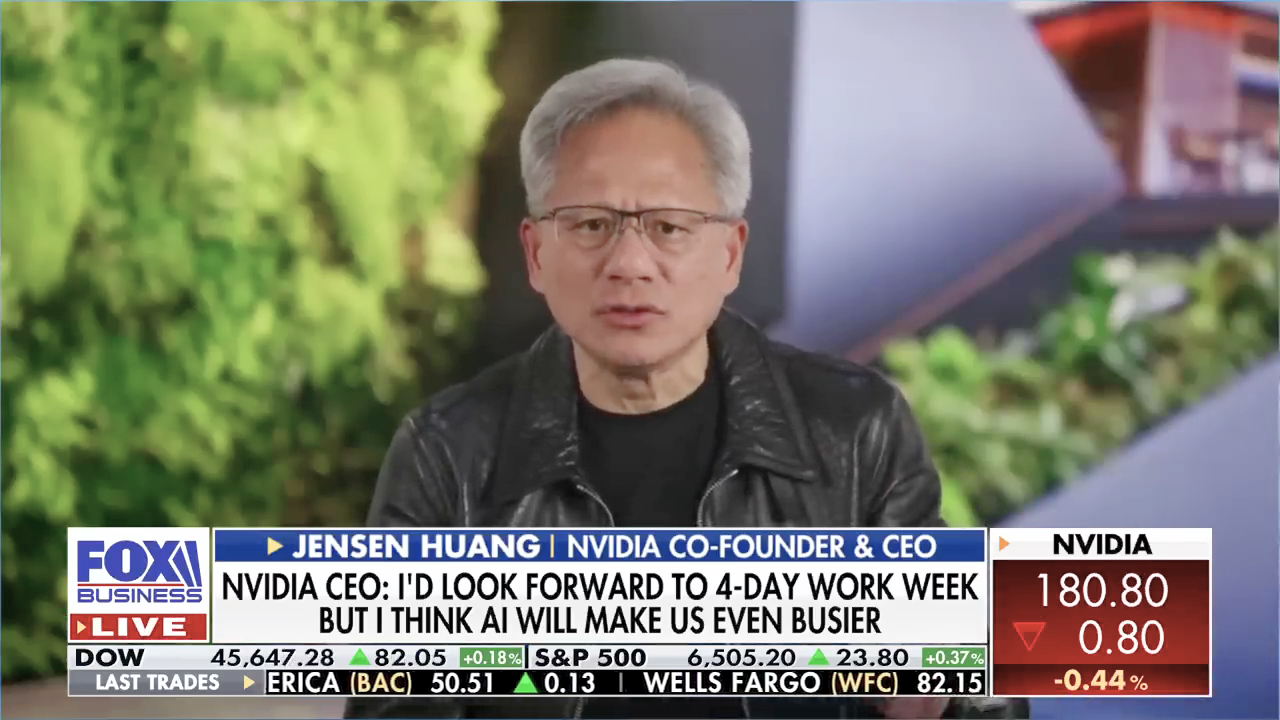
CALIFORNIA, UNITED STATES — Nvidia CEO Jensen Huang has projected that the rise of artificial intelligence could usher in widespread four-day workweeks, echoing past industrial revolutions that changed societal norms.
Speaking to Fox Business Network‘s Liz Claman, Huang stated, “We came from a world of seven-day workweeks. And now we’re in five-day workweeks. Every industrial revolution leads to some change in social behavior,” and suggested that increased automation and AI could drive lasting change in the nature of work.
This vision comes as industries worldwide experience rapid AI adoption, with companies streamlining operations and redefining employee roles.
“Some jobs will go away,” Huang admitted. “Many jobs will be new and invented. But one thing for sure, every job will be changed as a result of AI.”
He went on to add, “Life quality will get better, of course, over time.”
Accelerating business pace in the AI era
Despite the possibility of working fewer days, Huang cautioned that the pace of business might not slow down.
“I have to admit that I’m afraid to say that we are going to be busier in the future than now,” he said, highlighting AI’s power to expedite once time-consuming tasks.
Huang described this as enabling business leaders to act on more ideas with greater speed: “The more productive we are, the more opportunity we get to go pursue new ideas.”
Huang made these remarks in the wake of Nvidia’s record $46.7 billion second-quarter earnings, with the company continuing to lead in the AI hardware market.
Global trends: Four-day weeks and higher productivity
In the Netherlands, 32-hour workweeks are common and enthusiastically embraced by employees.
Pilot programs in Britain and North America have shown that reducing schedules to four days led to a dramatic 24% increase in productivity, reduced burnout by half, and lowered turnover. These organizations rarely revert to five-day schedules after making the switch, underlining the appeal and effectiveness of shorter weeks.
The business case is further supported by recent predictions from Bank of America Research, which foresees a sweeping productivity boom for S&P 500 companies.
Savita Subramanian, Head of U.S. Equity & Quantitative Strategy at BofA Research, explained to Fortune, “If you’re productive, you are doing things more efficiently, you need less labor. And this is more labor efficiency than anything else.”







