
Opendoor closes India operations entirely as AI replaces offshore work

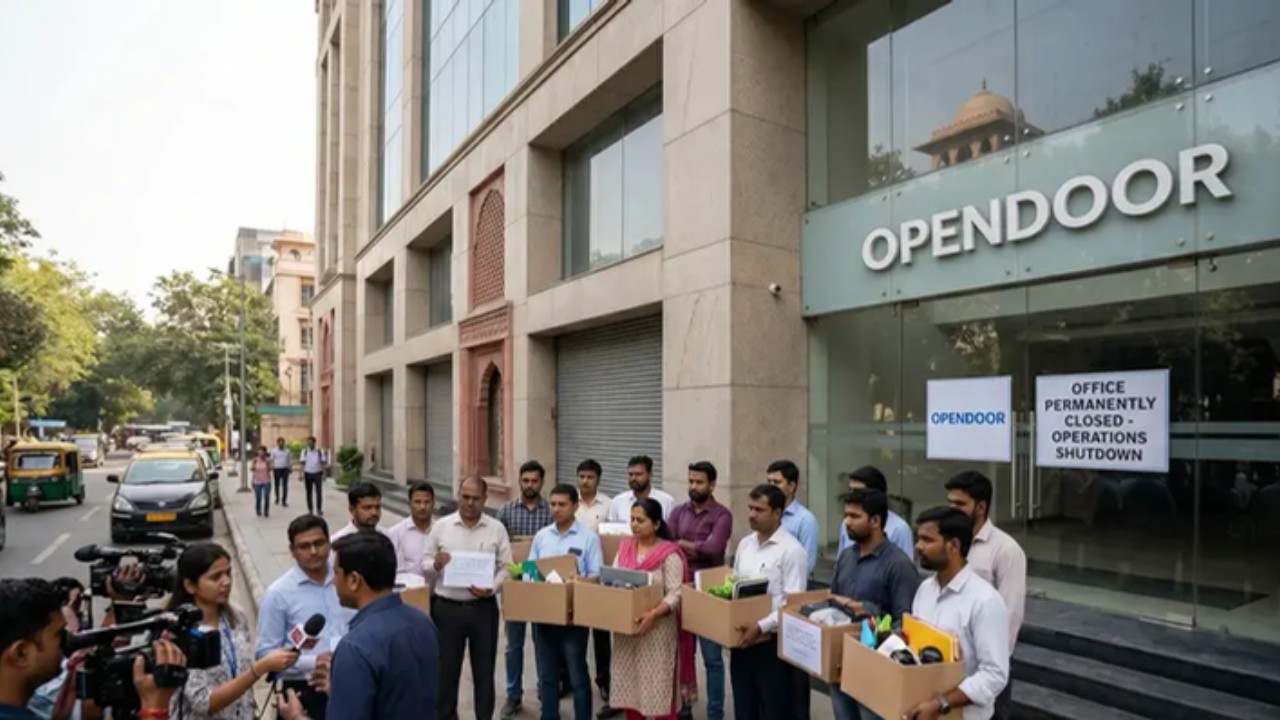
- Opendoor is closing its India operations and laying off 250 employees
- The Chennai and Bengaluru offices were established in 2024
- Global workforce fell from 1,470 to 1,042, a 29% reduction
- Non-US employees dropped from 342 to 184 over the same period
BENGALURU, INDIA — United States proptech company Opendoor is shutting down its India operations entirely — laying off 250 employees across Chennai and Bengaluru offices established in 2024 — as the company’s ‘Opendoor 2.0’ restructuring replaces offshore manual workflows with AI-native processes managed by smaller United States-based teams.
The closure is among the most direct documented cases of a US tech company explicitly citing AI automation as the reason for eliminating offshore headcount rather than reducing it.
Opendoor 2.0 replaces offshore workflows with AI-native US teams
According to a report from Meyka, Opendoor launched ‘Opendoor 2.0’ months before the India closure, consolidating fragmented systems and rebuilding operations around AI-native processes with smaller, US-based teams — a redesign that made the offshore manual workflow capacity in Chennai and Bengaluru structurally redundant.
The dual rationale — AI eliminating manual offshore workflows AND US customer proximity as a strategic requirement — is more significant than either reason alone: Opendoor is not cost-cutting offshore, it is architecturally redesigning its operations around AI automation with physical proximity as a design principle.
Opendoor’s global workforce contracted from 1,470 at end-2024 to 1,042 at end-2025 — a 29% reduction — with non-US employees falling from 342 to 184 over the same period; the India closure eliminates the majority of what remained.
AI-for-offshore displacement arrives in India’s GCC market
Opendoor’s chief executive cited two explicit reasons for the closure: customers are in the United States so operational work belongs closer to them, and AI and automation have eliminated the need for large offshore teams previously handling manual workflows.
The closure affects 250 employees across two offices — a severance package with outplacement services and transition support is in place, while a small team remains temporarily for workstream migration.
India’s GCC market employs 2.36 million workers across 2,100-plus centers generating approximately $100 billion annually — at that scale, Opendoor’s 250-person closure is a signal, not a market shock, but it is a documented case that connects AI-native redesign directly to offshore elimination.
The ‘Opendoor 2.0’ framing positions AI as the enabling architecture of a new operational model, not a cost-reduction tool — the distinction that separates architectural displacement from standard corporate downsizing, and the more threatening scenario for offshore operators to track.
For BPO and offshore IT operators, Opendoor’s India closure documents a loop that has been predicted but rarely confirmed with this specificity: a US company completes an AI-native operational redesign, the manual workflow volume that justified offshore capacity disappears, and the offshore offices close.
Whether Opendoor’s model generalizes depends on how many other US companies are running comparable AI-native redesigns — and how many are at the same stage of completion.
Related news
- Cambodia emerges as SE Asia’s next tech outsourcing destination · 19 Jun
- N-able eyes 50% India workforce growth as cyber threats go AI-native · 19 Jun
- India’s agentic AI returns set to hit $14.4Mn, a 5x surge: SAP · 18 Jun
Disclosure: Outsource Accelerator uses AI tools in the backend of its editorial workflow. Every article is reviewed and verified by a human editor before publication.
Stay ahead of the outsourcing industry. Join thousands of business leaders who rely on Outsource Accelerator for the news, trends, and expert insights that matter. Subscribe to our free newsletter and never miss an update.








