
Philippine BPOs expand to provinces amid real estate shift: Colliers

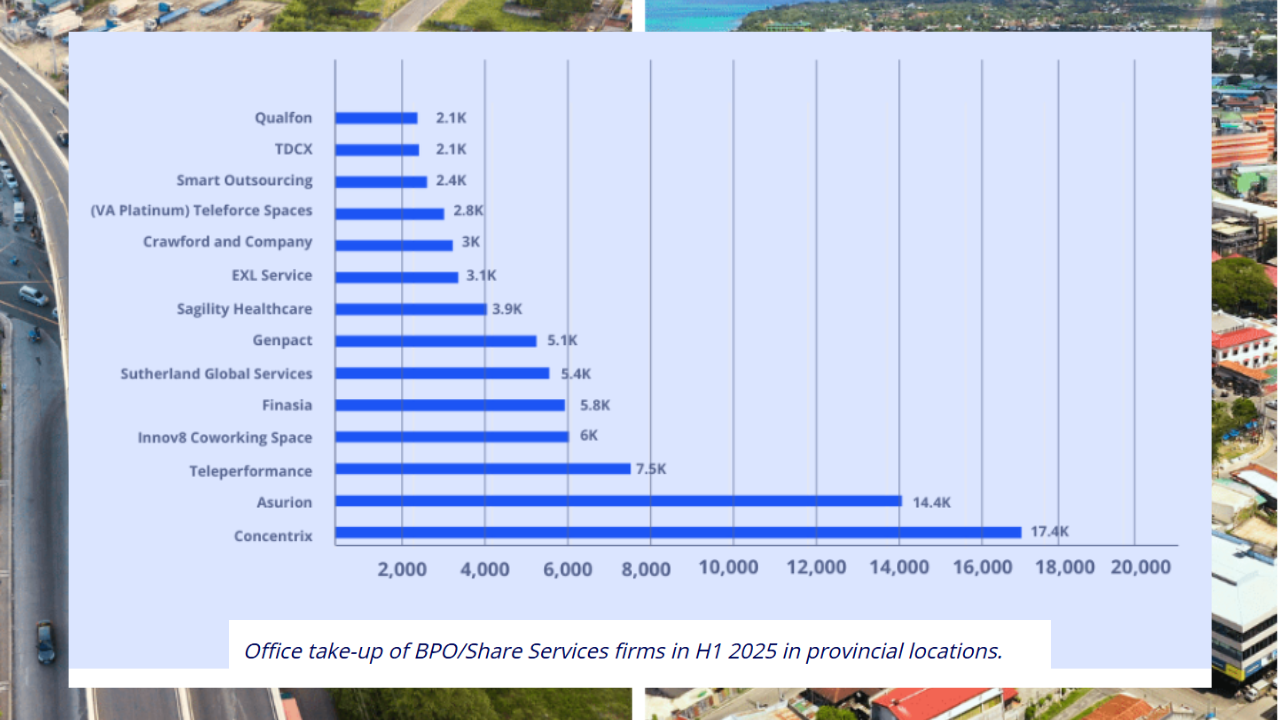
MANILA, PHILIPPINES — The Philippine business process outsourcing (BPO) sector is accelerating its expansion beyond Metro Manila as firms seek cost-efficient, talent-rich locations in the provinces, according to a Colliers‘ report.
This shift is redefining the country’s office landscape, signaling a new phase of growth for an industry that continues to drive the real estate market and the national economy.
Provinces emerge as new growth centers
In the first half of 2025, BPOs and shared services firms accounted for 293,000 square meters of office transactions, nearly half of the total 605,000 sqm recorded across the country, according to Colliers Philippines.
“This near parity underscores the BPO sector’s resilience and its pivotal role in shaping office real estate market demand,” the firm said in its latest report.
As vacancy rates in Metro Manila hover around 20%, many outsourcing firms are turning to the provinces for expansion. Locations such as Bohol and Cavite are emerging as attractive alternatives due to lower costs, government incentives, and the availability of skilled talent.
Concentrix led the provincial expansion with 17,400 sqm in new office space, followed by Asurion with 14,400 sqm, the report added.
In Bohol, new developments such as the MGO Business Complex and Bellemar in Panglao are transforming the province into a potential BPO hotspot.
Meanwhile, Maplecrest in Cavite is building nine new office towers, each spanning 3,000 sqm, catering to outsourcing firms seeking strategic suburban sites.
Industry faces global and tech challenges
Despite strong domestic expansion, the sector faces uncertainty from international policy moves, such as the Keep Call Centers in America Act of 2025, which could affect outsourcing relationships with United States-based clients.
The proposed legislation requires advance notice before offshoring and could bar firms that move jobs abroad from federal contracts.
At the same time, automation and AI are transforming the industry’s operational footprint. The IT and Business Process Association of the Philippines (IBPAP) reported that 67% of IT-BPM firms are now integrating AI tools such as UiPath, Automation Anywhere, and Genesys Cloud AI, reducing the need for large physical office spaces.
As the outsourcing landscape evolves, the shift toward provincial expansion appears not only practical but strategic. Beyond cost savings, the move decentralizes opportunities, nurtures regional economies, and enhances business continuity amid natural and geopolitical risks.
For an industry that contributes $40 billion annually and employs nearly 1.9 million Filipinos, this transition marks a critical pivot—one that could redefine the Philippines’ standing as a resilient global outsourcing powerhouse.







