
Philippines flexible workspace market sees rebound: Colliers

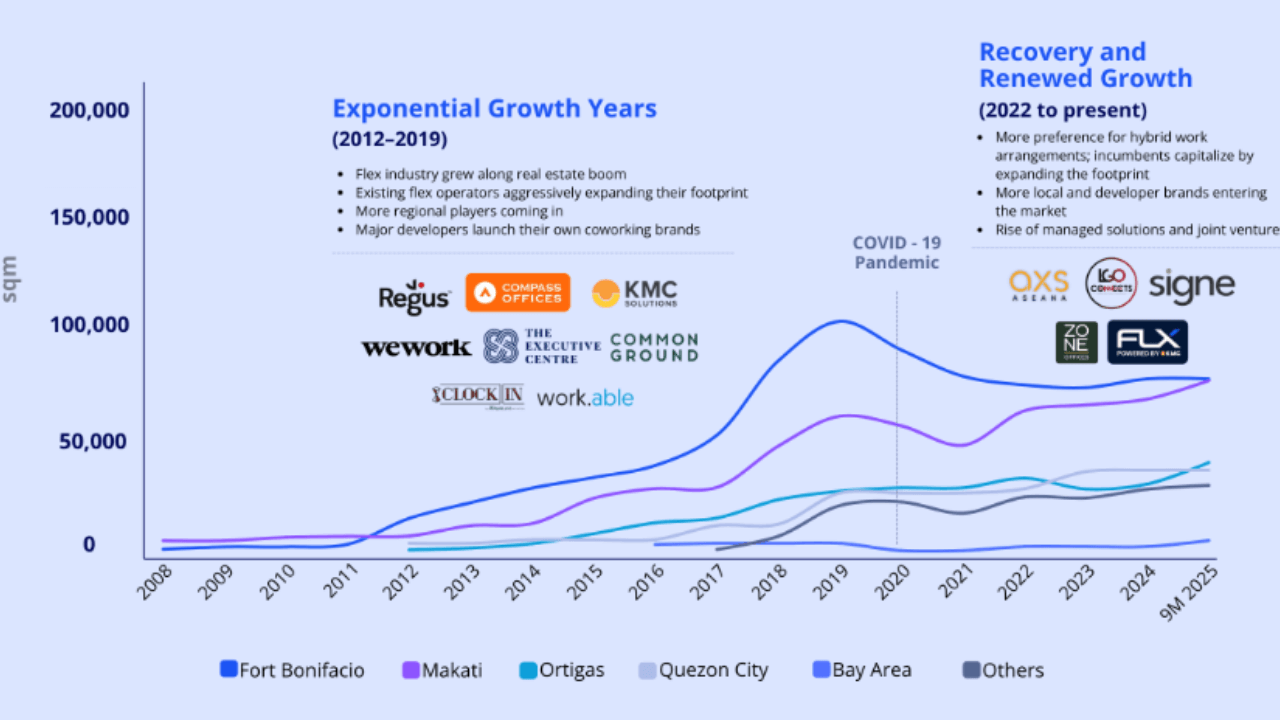
MANILA, PHILIPPINES — The Philippine flexible workspace market is showing strong signs of recovery after pandemic-era disruptions, driven by the rise of hybrid work, digital entrepreneurship, and shifting office strategies among corporations, according to a new market analysis by Colliers Philippines.
From niche to mainstream: Industry evolves with hybrid work
Colliers noted that the country’s flexible workspace industry has undergone a significant transformation over the past two decades.
The report noted that what once started as a niche alternative to conventional office leases has now become a widely adopted solution among landlords, tenants, and both local and global companies.
The sector’s early expansion is closely tied to the country’s role as a global outsourcing hub, enabled by tax incentives and economic zones established in the late 1990s.
As the business process outsourcing (BPO) industry scaled, so did demand for short-term, plug-and-play office solutions suitable for fast-growing teams.
The rise of the gig economy and remote digital work further accelerated this shift.
Coworking spaces and serviced offices emerged to address these needs, offering shorter lease terms, turnkey setups, and collaborative environments that support modern work culture.
These spaces also became hubs for community building, networking, and entrepreneurship, marking a shift from traditional long-term office leasing models.
Pandemic disruption led to rapid recovery, expansion
The pandemic in 2020 brought a sharp reversal, with flexible workspace vacancies reaching a record 41% as companies either transitioned to remote work or downsized their operations. Inventory contracted by 53,000 square meters, reflecting the steepest decline in the sector’s history.
However, Colliers reported a rebound beginning in 2022, with vacancy rates dropping to 18% and new leasing activity surpassing pre-pandemic levels.
By late 2025, the flexible workspace inventory had expanded to 267,000 square meters, equivalent to 49,500 seats.
Operators, including KMC Solutions and IWG, are expanding aggressively outside Metro Manila into Cebu, Pampanga, Iloilo, Bacolod, and Davao—reflecting decentralization trends in both work and business operations.
Meanwhile, landlords have begun forming joint venture agreements with flex providers to activate underutilized office space.
Colliers said the industry is now entering a new phase marked by agility, decentralization, and strategic innovation.
Outsourcing sector drives stable demand for flexible offices
This rebound aligns closely with the continued strength of the outsourcing industry. As BPOs adopt hybrid work and diversify their office locations nationwide, flexible workspace operators are well-positioned to support this expansion while reducing upfront capital requirements.
The resurgence highlights the sector’s strategic role in facilitating workforce mobility, suggesting that flexible spaces are no longer merely alternatives but key components of long-term workplace planning.







