
Retailers adapt as GenAI drives early consumer decisions: IBM-NRF

NEW YORK, UNITED STATES — Generative artificial intelligence (AI) is reshaping the retail landscape, prompting brands and stores to adapt as consumers make key shopping decisions before ever stepping into a store or opening an app.
A new global study by the IBM Institute for Business Value, in collaboration with the National Retail Federation, finds that nearly half of shoppers now turn to AI early in their buying journey, signaling a shift in how retailers must engage customers.
How AI guides consumers before they shop
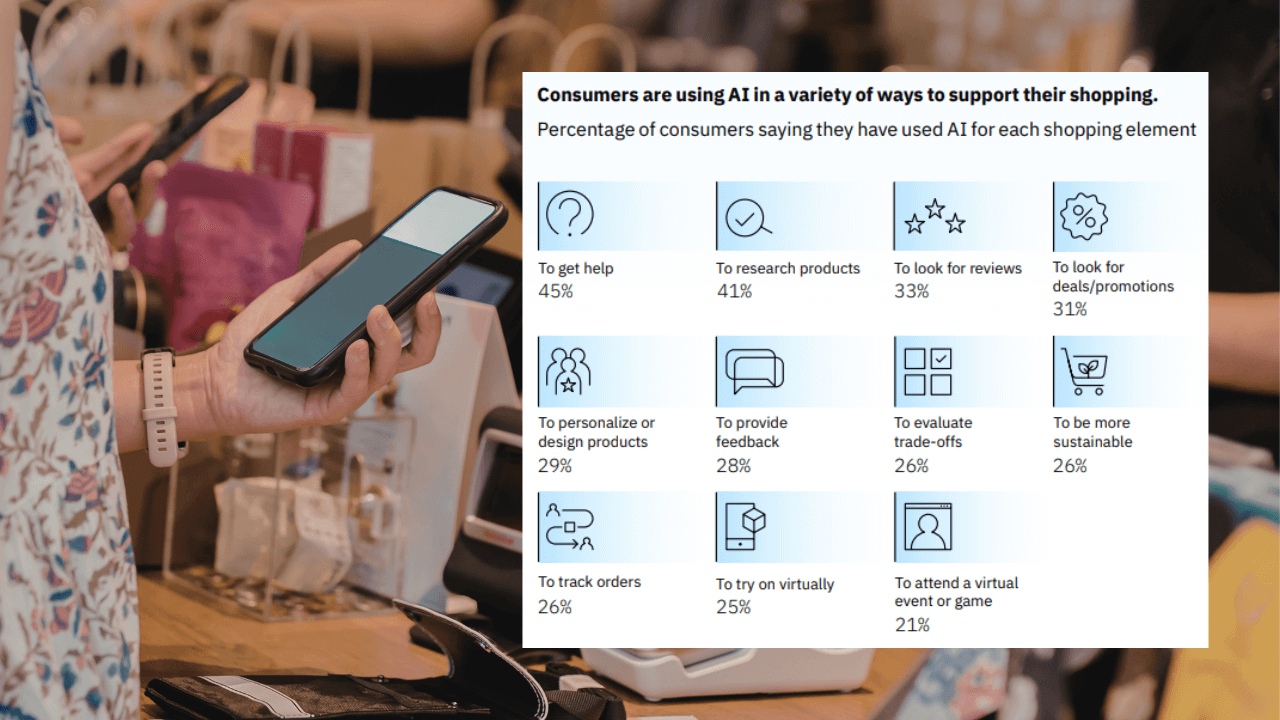
While 72% of consumers still prefer in-store shopping, the study found 45% turn to AI for guidance on what to buy.
Customers are progressively turning to AI for product research (41%), review analysis (33%), and deal finding (31%), thus going to the shops knowing exactly what they want.
“AI is changing how consumers shop, and every aspect throughout the shopping journey,” said Caroline Reppert, Senior Director, AI and Technology Policy at the National Retail Federation.
“As these technologies increasingly guide consumer discovery, comparison, and choice, retailers that understand and respond to this shift will be best positioned to earn trust, relevance, and long-term customer loyalty,” Reppert added.
For brands, AI is no longer just a search tool—it is becoming a trusted advisor.
“AI is turning shopping into a trusted conversation, much more than a search. Consumers now rely on assistants that feel almost human, know their preferences, and offer neutral, best-for-me advice that reshapes how they validate and decide what to buy,” said Matthieu Houle, CIO at ALDO Group.
Retailers race to meet AI-driven shoppers
Despite ongoing interest in visually appealing, wait-free stores (35%), many consumers are looking for AI-enabled experiences, including super apps (34%), AI personal shoppers in smart homes (30%), and seamless social commerce (29%).
Retailers face the challenge of ensuring their data is ready to guide these AI-driven decisions.
“AI is not a magic wand,” said Stanislas Vignon, Head of Insights (AI and Omnichannel) at Louis Vuitton Moët Hennessy.
“If you don’t have the right data, it doesn’t work. And you must test your solution to know whether it works and where it will bring value,” Vignon added.
The study underscores the need to reform consumer experiences near AI contact points, dispelling doubts through smart agents, enhancing brand distinctiveness, and leveraging AI human resources and alliances as key support.
More than half of executives (51%) cited limited internal AI expertise as a barrier, underlining the need for strategic collaboration.
For the broader outsourcing and retail sectors, the findings display a significant change. The brands that recognize the initial decision-making trends will be better placed to compete, while the ones that just respond risk losing their position.
In a time when insight and speed are the main criteria for success, knowledge of AI-based customer conduct might be the key to both retailers and their outsourcing partners.







