
U.S. workplace AI adoption stalls as usage gap widens: Gallup

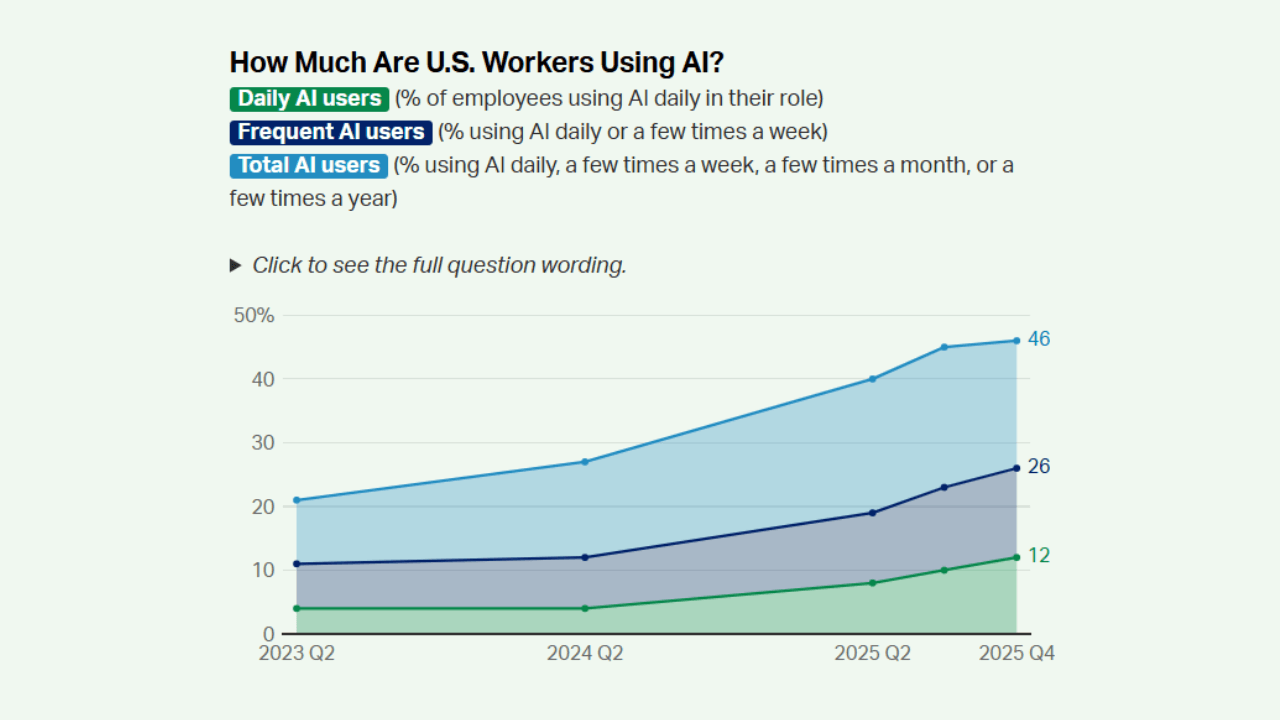
NEW YORK, UNITED STATES — New data from 2025 reveals a deepening divide in how American workers use artificial intelligence (AI).
According to Gallup’s latest report, frequent AI use continues a gradual climb, yet overall adoption has stalled, with 49% of employees reporting “never” using it, and significant disparities persist across industries and job roles.
AI adoption trends across industries
Another Gallup report notes, “U.S. employees working in knowledge-based jobs, such as technology or professional services, were more likely to use AI than those in frontline positions.”
The highest adoption is reported among employees in technology, finance, and higher education, with total adoption of 77%, 64%, and 63%, respectively.
On the other hand, retail, manufacturing, and healthcare are far behind, with only 33%, 38%, and 37% total adoption, respectively.
This is increasing faster, and the gap between early-adopting and lagging industries is widening. The increase in the total number of users was largest in the finance and professional services sector, with a growth of 5 and 6 percentage points in the fourth quarter of 2025, respectively.
In the meantime, areas with already high adoption rates, such as technology, are growing at a slower pace, with success largely due to more frequent use by current adopters than by new adopters.
Impact of leadership and remote work on AI usage
An evident pyramid system of AI will form, with organizational leaders and employees increasingly able to work remotely using AI.
Moreover, the frequency of use among leaders has soared from 17% to 44%, far higher than that of individual contributors, who use AI frequently, from 9% to 23%.
The nature of one’s role is a critical factor, with AI tools permeating remote-capable jobs much faster. By 2023, the proportion of AI applications in these jobs had increased by a staggering 28% to 66%, with 40% of users now utilizing it frequently.
This aligns with global findings from Microsoft and LinkedIn, which indicate that 75% of knowledge workers worldwide are now using AI, often bringing their own tools to the workplace to keep up with demand.
The report notes that “part of this difference likely reflects role type, as leaders are more likely to hold office-based and remote-capable roles where AI tools are more easily applied.”
Not remote-capable or production- or service-based, adoption has been much slower in other jobs, where only 32% overall adoption and 17% frequent use by 2025 have been achieved, indicating an essential accessibility and applicability gap.
The stalled growth in overall AI use risks creating a permanent divide, where enhanced workers pull ahead, and others are left competing without it.







