
AI boom is growing offshore call centers, not shrinking them

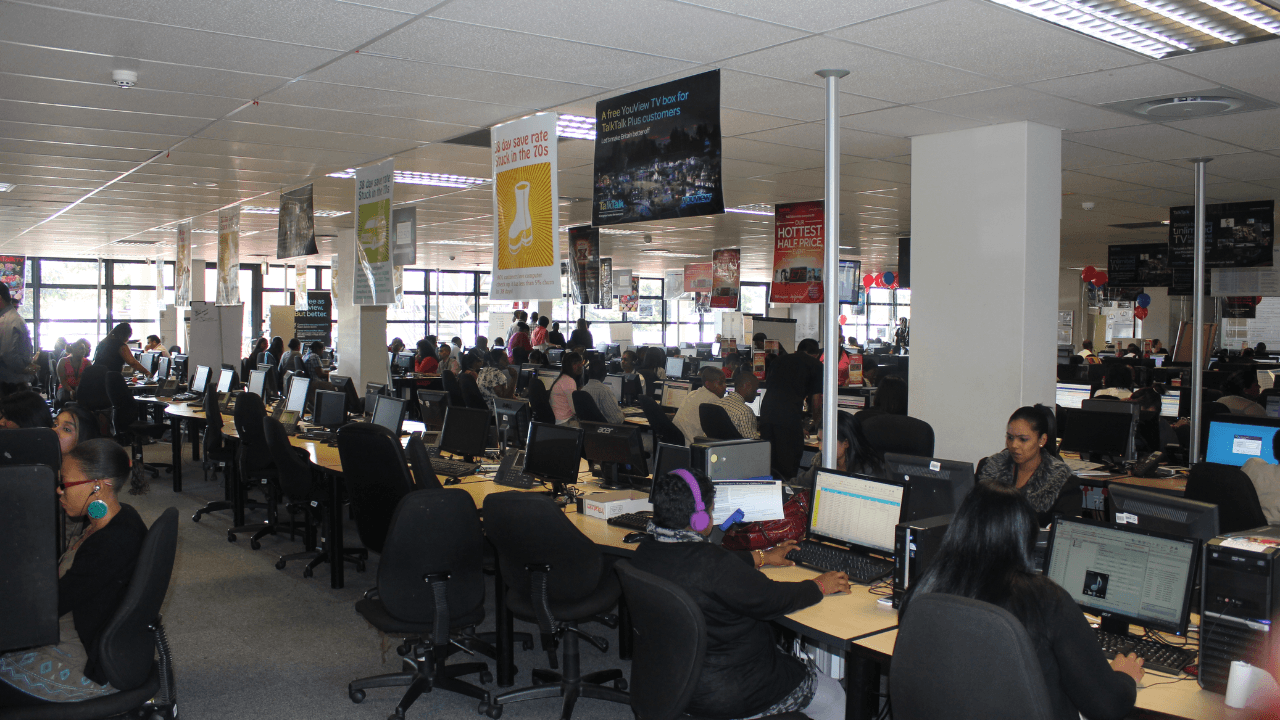
- Philippine call center employment nearly doubled from 2016 to 2025
- It reached 2 million workers
- Unemployment fell from 9% in 2021 to roughly 4% in March 2026
- A Stanford study found AI raised agent productivity 14% per hour
NEW YORK, UNITED STATES — Employment in the Philippines‘ call center sector nearly doubled from 2016 to 2025, reaching 2 million workers — even as artificial intelligence (AI) reshaped customer service operations worldwide and major United States companies cut thousands of domestic support roles.
AI efficiency is expanding demand, not eliminating it
Economists are reaching for a 19th-century principle to explain the apparent contradiction.
According to Fortune, Torsten Slok, chief economist at Apollo Global Management, describes it as Jevons Paradox — the observation documented by English economist William Stanley Jevons in 1865, when improvements in steam engine efficiency drove higher coal consumption rather than lower.
“Lower cost per interaction does not mean fewer interactions,” Slok said. “It means more customers served, more channels opened and more markets worth reaching.”
The Philippines‘ unemployment rate fell from 9% in 2021 to roughly 4% in March 2026 — a labor market tightening that coincides directly with AI’s acceleration into service industries.
Filipino call center workers earn between PHP 15,000 and PHP 120,000 (US$243 to US$1,948) per month, compared with US$2,866 per month for their U.S. counterparts — a cost gap AI tools are widening.
Past automation fears have consistently proved wrong
The pattern has precedent across industries. Christoph Herpfer, a professor at the Darden School of Business, points to radiology — a field once widely predicted to be automated away — where U.S. employment rose 10 percent over the past decade.
“We actually have a huge shortage of radiologists,” Herpfer said. “The exact opposite of this prediction has happened.”
The Brookings Institution estimates 86 percent of customer service representative tasks carry high automation potential. A 2023 Stanford University study nonetheless found AI conversational tools increased agent productivity 14% per hour across more than 5,000 workers — making interactions cheaper to deliver, not the workers redundant.
Salesforce cut 4,000 customer service positions in September 2025, with CEO Marc Benioff saying the company needed fewer workers — yet Philippine and Indian BPO employment continued to grow over the same period, underscoring how company-level cuts can diverge from sector-wide growth.
The global business process outsourcing (BPO) market was valued at approximately $280 billion in 2023 and is projected to surpass $500 billion by 2030, according to industry analysts, with North America generating the largest share of worldwide demand.
As AI reduces the cost per interaction, markets previously too expensive to reach — by language, region or service category — are becoming viable for the first time, expanding the total addressable offshore workforce rather than shrinking it.
Related news
- India’s $175Bn AI data city plan draws investors, to boost outsourcing · 21 Feb
- Outsourcing emerges as South Africa’s new economic goldmine · 29 Oct 2025
- Filipinos steer Japan’s robots as AI jobs move offshore · 27 Oct 2025
Disclosure: Outsource Accelerator uses AI tools in the backend of its editorial workflow. Every article is reviewed and verified by a human editor before publication.
Stay ahead of the outsourcing industry. Join thousands of business leaders who rely on Outsource Accelerator for the news, trends, and expert insights that matter. Subscribe to our free newsletter and never miss an update.








